



By Ewen Ling, Co-Founder, Referwo | Ecommerce Growth Strategist
Last updated: September 2026
Affiliate marketing in Australia is a performance-based model where you earn a commission every time someone clicks your unique referral link and makes a purchase, no product creation, no inventory, and no customer service required. The commission is paid only when a result is delivered, which makes it one of the most accessible online income models available to individuals, and one of the most cost-efficient acquisition channels available to ecommerce brands.
Australia’s affiliate marketing sector continues to grow as online retail spending increases. More brands are launching affiliate programs, more creators are monetising their audiences through commissions, and more ecommerce businesses are using performance-based influencer partnerships alongside traditional affiliate arrangements. This guide covers everything you need to operate in that space: choosing your niche, evaluating programs, creating content that converts, tracking results, meeting your legal obligations, and getting started.
Quick answer
Affiliate marketing in Australia works best when you pick one niche with confirmed demand, join 2–3 programs with strong commission rates and reliable tracking, and produce content that answers your audience’s real questions before recommending products. Legal disclosure under ACCC guidelines is mandatory. Earnings are a lagging indicator, they reflect work done months earlier, not effort made today.
What Is Affiliate Marketing and How Does It Work?
Affiliate marketing is a three-party arrangement, the affiliate, the merchant, and the customer, where the affiliate earns a commission by driving a specific action, usually a purchase, through a unique tracking link. Payment is triggered only by a confirmed result. That is what separates affiliate marketing from paid advertising, where spend is incurred regardless of outcome.
Affiliates promote merchants’ products through their own channels, blogs, social media, email lists, or YouTube, using links provided by the merchant or by an affiliate network. Affiliate networks act as intermediaries: they connect affiliates with merchants, handle the tracking infrastructure, and manage commission payments. Well-known networks active in Australia include Commission Factory, Rakuten Advertising, and Impact.
The appeal of affiliate marketing is its scalability. Once a piece of content is published and ranking, it can generate commissions without ongoing promotion spend. That said, affiliate marketing is not passive income from day one, it is income that becomes more passive after sustained effort. Building the audience and producing the ranking content is the work. The passivity comes later.

The Most Profitable Affiliate Marketing Niches in Australia
The five most profitable affiliate marketing niches in Australia are health and wellness, fashion and beauty, home improvement, travel and tourism, and personal finance. Profitability depends on three factors: audience demand, available commission rates, and your ability to build genuine authority in that space. Chasing commission rates without audience fit is the most common mistake new affiliates make, a 20% commission on a product your audience never searches for generates nothing.
Health and Wellness
Australia’s health and wellness sector generates significant affiliate commission opportunity across supplements, fitness programs, natural skincare, and mental wellness apps, with commissions typically ranging from 5% to 20% depending on the product category and merchant.
Generic roundups (“best protein powder in Australia”) compete directly with major media publishers and are hard to rank. Targeting a specific audience, postpartum fitness, athletes in a particular sport, people managing a particular dietary requirement, paired with products that genuinely fit their needs outperforms broad content every time.
Fashion and Beauty
Australia’s fashion market combines strong interest in local designers, sustainable clothing, and international brands. Beauty, particularly skincare , drives consistent year-round search volume. Commissions typically sit between 5% and 15%. Visual content performs strongly here, making this niche well-suited to Instagram and TikTok channels alongside SEO-driven blog content. For brands looking to scale through creator partnerships, working with fashion influencers through structured affiliate arrangements delivers measurable returns.
Home Improvement and DIY
Home renovation, interior design, and DIY projects remain high-interest topics in Australia, sustained by remote work trends and growing interest in energy efficiency and sustainable living. Hardware retailers and home improvement brands offer commissions in the 3% to 8% range, but high average order values mean each commission can be substantial. Long-form instructional content, project walkthroughs, comparison guides, tutorials, performs well in this niche.
Travel and Tourism
Australia’s domestic travel market is strong, and international travel has fully rebounded. Affiliates earn commissions from accommodation platforms, tour operators, airlines, and travel gear brands. The niche is competitive at a broad level, but profitable sub-niches remain underserved: adventure travel, eco-tourism, accessible travel, and family travel with young children all have engaged audiences and less direct competition. Travel content requires consistent updates, stale booking conditions and outdated pricing reduce conversion rates significantly.
Personal Finance and Investment
Personal finance is among the highest-paying affiliate niches available, credit cards, investment platforms, and mortgage comparison services all run programs with commissions that can exceed $100 per qualified lead. The trade-off is regulatory complexity. Financial product recommendations in Australia may trigger obligations under the Corporations Act depending on how content is framed. Affiliates in this space must avoid content that reads as personal financial advice and should include clear disclaimers directing readers to licensed professionals for major decisions.

How to Find and Evaluate Affiliate Programs in Australia
The right affiliate program combines strong commission rates, reliable tracking, relevant products, and a merchant whose reputation you are comfortable associating with your brand. A program paying 15% commission on a product your audience will never buy is worth less than one paying 5% on a product they actively search for. Start with relevance, evaluate commission rate second.
Commission Rate and Cookie Duration
Two numbers define the earning potential of any program: the commission rate and the cookie duration. Cookie duration determines how long after a click you can still earn commission on a customer’s purchase, a 30-day window is standard. Anything shorter significantly reduces your earnings, particularly in considered-purchase categories where customers research before buying. Programs offering recurring commissions on subscription products are worth prioritising where they exist, a subscriber who stays active pays commission every month.
Tracking and Reporting
Reliable tracking is non-negotiable. Before joining any program, confirm the attribution methodology (first-click, last-click, or multi-touch), how cross-device purchases are handled, and the process for resolving tracking disputes. Programs using outdated infrastructure will cost you commissions with no visibility into why they are being missed.
Program Policies and Restrictions
Review terms carefully before promoting. Note any restrictions on paid search, coupon sites, or social media advertising, these affect how you scale. Some programs also have minimum traffic thresholds or exclusivity clauses that limit your ability to promote competing products.
Using Referwo as Your Affiliate Platform
For creators and affiliates working with Australian ecommerce brands, Referwo connects you with brands running gifted, paid, and commission-based campaigns, with tracking, reporting, and payment handled in one place. For brands, Referwo provides a single system to manage gifted, paid, or affiliate influencer campaigns without building separate tools for each campaign type.

Creating Affiliate Content That Actually Converts
Affiliate content converts when it answers the reader’s real question directly, recommends products from a position of genuine authority, and makes the path to purchase clear. Content optimised for search volume without serving the reader converts poorly, and, in a post-Helpful Content environment, ranks poorly too. The reader’s intent and the affiliate’s commission are aligned: useful content is converting content.
Know Your Audience Before You Write
Effective affiliate content is written for a specific reader, not a general one. Before producing anything, identify exactly who you are writing for: their knowledge level, what they have already tried, what they are afraid of, and what outcome they want. Start with audience research, time spent in forums, Reddit communities, and Facebook groups where your audience asks questions. The language they use to describe their problems is the language your content should use.
Content Formats That Work in Affiliate Marketing
Different formats serve different points in the buyer journey:
- Comparison articles (“X vs Y”) target readers close to a purchase decision, conversion potential is high.
- Best-of roundups (“Best [product] in Australia”) capture readers in the research phase, traffic is higher, conversion rate lower.
- Tutorials and how-to guides attract readers who are learning and introduce products as tools that make the process easier.
- Product reviews serve readers who have shortlisted a specific product and want independent validation before buying.
Video content, YouTube tutorials and TikTok demonstrations, is increasingly effective because it shows a product in use rather than describing it. Demonstrations that include honest limitations convert more credibly than content that only highlights benefits.
Balancing Promotion and Authenticity
The fastest way to lose an affiliate audience is to recommend products you have not tested or do not believe in. Your audience’s trust is the asset your affiliate income depends on, and trust, once broken, is very difficult to rebuild. Disclose your affiliate relationships clearly (a legal requirement covered below). Distinguish between products you use personally and products you have researched but not used. Specificity is what makes a recommendation credible rather than transactional.

Tracking Performance and Making Data-Driven Decisions
Effective affiliate marketers measure every link, every content piece, and every traffic source, not to satisfy reporting requirements, but because the data shows what is actually working. The most common reason affiliate marketing stalls is producing content without understanding which content converts, then repeating the same approach and wondering why income does not grow.
Key Performance Indicators to Monitor
Three KPIs matter most:
- Click-through rate (CTR): the percentage of readers who click your affiliate link. A low CTR indicates your call to action or product recommendation needs work.
- Conversion rate: the percentage of clicks that result in a completed purchase. A low conversion rate with a high CTR suggests a mismatch between your audience and the product, or a problem on the merchant’s landing page.
- Earnings per click (EPC): how much you earn for every reader who clicks your affiliate link. EPC combines CTR and conversion rate into one number, the clearest indicator of whether a program and audience are well-matched.
Tools and Platforms
Google Analytics 4 (GA4) is the baseline for any affiliate marketer, it tracks traffic sources, user behaviour, and goal completions. Pair GA4 with your affiliate network’s reporting dashboard to identify which content drives the most clicks and which drives the most conversions. The combination reveals mismatches you would not see from either data source alone.
For tracking affiliate influencer performance specifically, Referwo’s platform provides real-time tracking on clicks, sales, and commission payouts in one dashboard. For a deeper look at attribution and ROI measurement, see our guide on tracking ROI from influencer marketing with real campaign data.

Legal and Compliance Requirements for Australian Affiliate Marketers
Australian affiliate marketers are subject to three main areas of legal obligation: disclosure requirements under the Australian Competition and Consumer Commission (ACCC) guidelines, consumer protection obligations under Australian Consumer Law (ACL), and privacy obligations under the Privacy Act 1988. These are not optional, and regulators are increasingly active in this area. Non-compliance creates regulatory risk and damages audience trust simultaneously.
Disclosure Requirements Under ACCC Guidelines
The Australian Competition and Consumer Commission (ACCC) requires that any material commercial relationship between a content creator and a merchant be disclosed clearly and prominently. For affiliate marketing, this means disclosing that you earn a commission when readers purchase through your links, noticeable, not buried in a footer. A clear statement at the top of each piece of content that contains affiliate links meets the standard: “This article contains affiliate links. I may earn a commission if you purchase through them at no extra cost to you.” The ACCC’s position is that disclosure must happen at the point of decision, before the consumer clicks.
Australian Consumer Law Compliance
Australian Consumer Law (ACL) prohibits false or misleading representations. For affiliate marketers, this means you cannot make claims about product benefits you cannot substantiate. Exaggerated testimonials, fabricated results, and unverifiable statistics all carry risk under the ACL, across every content format, including social media captions and email newsletters. A useful test: would you be comfortable defending this claim in front of the ACCC? If not, do not publish it.
Privacy Act and Spam Act Obligations
If you collect email addresses through your affiliate activities, via newsletter sign-ups, lead magnets, or opt-in forms, you are subject to the Privacy Act 1988. This requires collecting only the data you need, storing it securely, disclosing how it will be used, and providing a mechanism for people to request removal of their data. The Spam Act 2003 adds a further requirement: all commercial electronic messages must include a working unsubscribe mechanism, and requests must be actioned promptly.

Pros and Cons of Affiliate Marketing in Australia
Affiliate marketing offers genuine advantages for both individual marketers and ecommerce brands, but it is not without trade-offs. Understanding both sides before committing significant time or budget sets realistic expectations and better decisions.
| Advantages | Disadvantages |
|---|---|
| Low startup cost – no inventory, product development, or customer service infrastructure needed. | Income instability – earnings depend on traffic, which shifts with algorithm updates and seasonal demand. |
| Performance-based for brands – brands pay only for confirmed results, not for reach or impressions. | Limited brand control – brands cannot fully control how affiliates represent their products. |
| Scalable income – content that ranks and builds trust generates commissions without ongoing promotion spend. | Fraud risk – click fraud, cookie stuffing, and fake leads are genuine risks without robust tracking and vetting. |
| Expanded audience reach – affiliates introduce products to audiences brands would not otherwise access. | Commission dependency – program terms can change at any time; a commission cut or program closure affects income immediately. |
| Flexibility – affiliates choose their niche, schedule, and promotional methods. | Slow to build – meaningful affiliate income typically takes 6 to 12 months to develop; it is not a short-term income solution. |

How to Get Started: a Four-Step Plan
Starting affiliate marketing in Australia comes down to four decisions made in the right sequence. Getting the order wrong, joining programs before building an audience, or producing content before confirming demand, is the most common reason early-stage affiliates stall.
- Choose your niche. Pick a topic you have genuine interest or expertise in, with confirmed commercial demand. Use Google Trends and keyword research tools to verify search volume before committing. A niche with minimal demand will not generate meaningful affiliate income regardless of content quality.
- Build your platform. A blog on your own domain is the most durable affiliate asset, you own it, you control it, and it is not subject to social media algorithm changes. Publish on social channels to supplement reach, but do not make them your only distribution method.
- Join 2–3 programs aligned with your niche. Start narrow rather than spreading across many programs at once. Understand the commission structure, cookie duration, and tracking method of each program before you begin promoting. Review terms carefully, restrictions on promotional methods can significantly affect how you scale.
- Produce content consistently. Affiliate income is a lagging indicator, commissions you earn today are the result of content produced months ago. Consistent content production is the only reliable path to growing affiliate income over time. Prioritise quality and search intent alignment over volume.
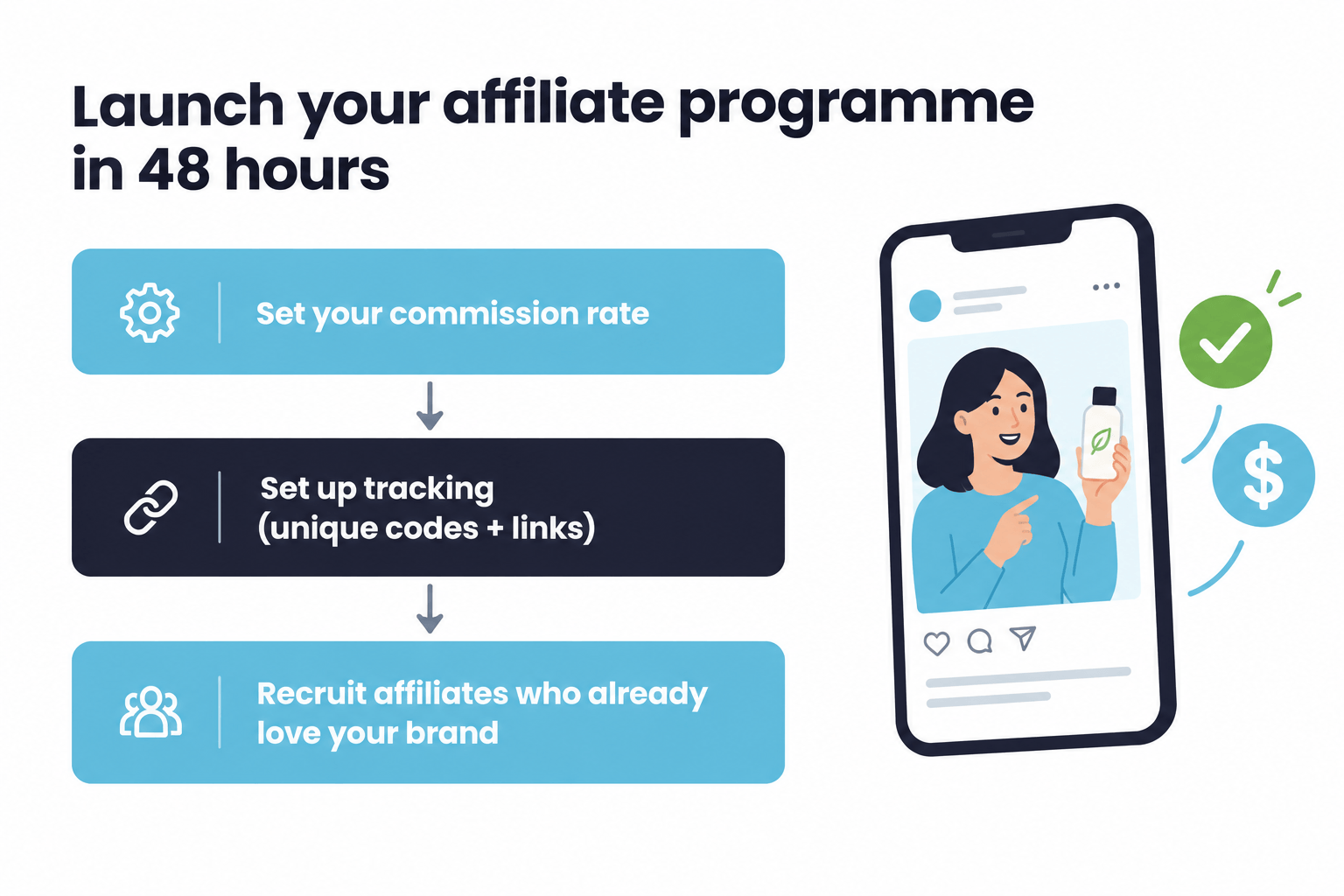
For ecommerce brands building performance-based affiliate partnerships with creators, the same principles apply. Choose creators whose audiences align with your product, use reliable tracking to attribute real sales, and commit to the relationship over time. The brands that see the strongest results from affiliate influencer marketing treat it as a long-term channel, not a one-off campaign tactic. For a step-by-step framework, see our guide to launching a high-impact influencer affiliate program.
Frequently Asked Questions
How much can you earn from affiliate marketing in Australia?
Earnings vary widely and depend entirely on niche, traffic volume, commission rates, and content quality. Beginners typically earn little in the first six months while building audience and content. Established affiliates in high-commission niches, personal finance, software, health, can earn several thousand dollars per month. There is no guaranteed income figure: affiliate marketing rewards sustained, quality effort over time, not quick output.
Is affiliate marketing legal in Australia?
Yes, affiliate marketing is legal in Australia. It is subject to disclosure requirements under the ACCC, consumer protection obligations under Australian Consumer Law (ACL), and privacy obligations under the Privacy Act 1988. Affiliates must clearly disclose commercial relationships to readers, must not make unsubstantiated claims about products, and must handle any personal data they collect in line with the Privacy Act. Compliance is straightforward for affiliates operating transparently.
What is the best affiliate marketing niche in Australia?
There is no single best niche, the right niche is one where you can build genuine authority, audience demand exists, and the products on offer pay commissions worth earning. Health and wellness, personal finance, and fashion all offer strong commission rates in Australia. That said, a niche you have real expertise in will consistently outperform a niche you chose for commission rates alone. Audience trust is what drives conversions, and trust is built through genuine knowledge and honest recommendations.
How does Referwo work for affiliate influencer marketing?
Referwo is an Australian influencer marketing platform that connects ecommerce brands with vetted creators for gifted, paid, and commission-based campaigns. Brands publish a campaign, creators apply, and Referwo tracks discount codes and commissions automatically, with real-time sales data visible to the brand at all times. It is built for brands that want performance-based results rather than reach-and-impressions metrics. A 14-day free trial is available on the self-serve plan, with a managed Premium option at $399 per month for brands that want hands-off campaign management.
What is the difference between affiliate marketing and influencer marketing?
Traditional affiliate marketing typically involves a publisher (blogger, comparison site, or content creator) promoting a product through tracked links in exchange for a commission. Influencer marketing involves a creator with an engaged social audience promoting a brand, usually through Instagram, TikTok, or YouTube, in exchange for payment, gifted product, or a commission. The two models increasingly overlap, performance-based influencer marketing, where creators earn commissions on sales they generate, is now a significant part of the Australian affiliate landscape. For a direct comparison, see our guide to affiliate vs gifted vs paid influencer campaigns.
The Bottom Line
Affiliate marketing in Australia rewards patience, specificity, and honesty. Build content that genuinely serves a specific audience, promote products you believe in, and measure what actually drives revenue, not what looks good in a vanity metric dashboard. The fundamentals have not changed; the execution bar has risen as the market has matured.
If you are ready to run affiliate campaigns where every creator’s performance is tracked to real sales, see how Referwo works for brands.

About the author
Ewen Ling is the co-founder of Referwo and an ecommerce entrepreneur with 16 years of hands-on experience. He co-founded Elinz Electronics in 2005 and scaled it into a fully operational business before managing a successful shareholder exit in 2021. At Referwo, Ewen helps ecommerce brands build influencer marketing programmes that generate measurable revenue, not just reach. His content is built from real campaign data and 16 years of commercial ecommerce experience.