


By Ewen Ling, Co-Founder, Referwo | Ecommerce Growth Strategist
Last updated: September 2026
Starting an ecommerce business in Australia comes down to six nuts and bolts: a niche with real demand, the right business model, reliable suppliers priced on their true landed cost, a legal set-up (ABN, GST, and consumer law), an online store that converts, and a marketing engine that brings customers in. Customer service holds all six together. Most new stores that fail get the store built and then have no plan for traffic.
That last point is where many founders stall. Building a Shopify store now takes days, not months. Getting strangers to trust a brand they have never heard of takes much longer. The founders who grow fastest plan the marketing engine at the same time as the store, usually by putting product in the hands of creators and customers who will talk about it.
I learned this first-hand building an ecommerce business from 2005 through to its sale in 2021. This guide rebuilds the practical checklist I wish I had at the start, updated for Australian rules and for how customers discover products in 2026.
Quick Answer
To start an ecommerce business in Australia, choose a niche with proven demand, pick a model (dropshipping, reselling, or your own brand), cost products at landed cost, register an ABN and check GST, build your store on a platform like Shopify, and launch with creator seeding. On Referwo, Sole Sox earned 6.5x return on ad spend from gifted and affiliate creators.
Key facts
- Online sales made up 12.7% of Australian retail turnover in June 2025, in original terms (ABS, 2025).
- Businesses must register for GST within 21 days of reaching $75,000 GST turnover (ATO).
- Imported goods valued at A$1,000 or less are treated as low value imported goods for GST (ATO).
- Consumer guarantees apply to online sales, including by overseas sellers to Australians (ACCC).
- Sole Sox: 127 creators, 186 pieces of content, $10,000 in sales, 6.5x ROAS (Referwo case study).
What are the nuts and bolts of an ecommerce business?
The nuts and bolts of an ecommerce business are the six decisions every store has to get right: niche, business model, product sourcing, legal set-up, the online store, and marketing. Customer service connects them. Each decision affects the next, so a niche with thin margins limits your marketing budget, and a slow supplier limits the service you can offer.

| Building block | The first decision | Common early mistake |
|---|---|---|
| Niche | Who you sell to and what problem you solve | Choosing a product you like with no evidence anyone will pay for it |
| Business model | Dropshipping, reselling, or your own brand | Picking the cheapest model without checking the margin |
| Product sourcing | Which supplier, at what landed cost | Pricing from the factory price and forgetting freight, GST, and fees |
| Legal set-up | ABN, business name, GST, and consumer law | Writing a no-refunds policy that breaks the consumer guarantees |
| Online store | Platform, payments, shipping, and returns | Spending months on design before a single product is tested |
| Marketing | How the first 100 customers will find you | Launching the store with no plan for traffic |
| Customer service | Response times and how problems are fixed | Treating service as a cost instead of a growth channel |
How do you choose an ecommerce niche that can actually sell?
Choose a niche where you understand the customer, where people already spend money, and where you can offer something the big retailers do not. A good niche for a new ecommerce brand is specific enough that creators and communities already talk about it, and broad enough to support repeat purchases or a range of related products.

Your own interests are a useful starting point because you will spend years in this category. Interest alone is not evidence of demand, though. Before you order stock, answer these questions in writing:
- Who exactly is the customer, and where do they already spend time online?
- What are they buying now, and what do they complain about in reviews?
- How many established brands already sell this, and how are they different from each other?
- What gross margin will you make after landed cost, payment fees, and shipping?
- Will customers buy again, or is this a one-off purchase?
- Are there creators in this niche whose audiences match your customer?
The last question is the one most founders skip, and it is the most useful early test. If you can find 20 creators whose followers look like your customers, you have a ready-made route to market. If you cannot find any, the niche may be too small or too hard to reach. Our guide to finding influencers as a small business in Australia shows how to run that search.
Which ecommerce business model should you choose?
Most new Australian stores choose between three models: dropshipping, reselling other brands’ products, or building their own brand. Dropshipping needs the least cash but gives the least control and the thinnest margins. Building your own brand needs the most upfront work and money, but it creates the highest margins and a product people can recommend by name.

| Model | Upfront cost | Margin and control | Fit with influencer marketing |
|---|---|---|---|
| Dropshipping | Low: no stock held | Low margin; supplier controls quality and delivery times | Weak: creators may find the same product elsewhere, and slow delivery hurts reviews |
| Reselling other brands | Medium: you buy stock from distributors or manufacturers | Medium margin; you control delivery but not the product | Moderate: works when you add expertise, curation, or bundles |
| Your own brand | High: samples, production run, packaging | Highest margin; you control product, packaging, and story | Strong: creators recommend your brand by name and you own the customer relationship |
Dropshipping works as a way to test demand, but relying on it long term is risky. When a customer receives an order weeks late, the negative review lands on your store, not the supplier’s. Reselling can work well when you add genuine expertise, for example curating the best products in a hobby and explaining how to use them.
Owning the brand is where most sustainable direct-to-consumer (DTC) businesses end up. A branded product gives creators something specific to review, lets you tell a story about why the product exists, and means repeat purchases come back to you. These three models are about how you hold stock and fulfil orders. For the different ways businesses and customers transact online, such as B2C and B2B, see our guide to the six most common ecommerce business models.
How do you find reliable suppliers and manufacturers?
Find reliable suppliers by ordering samples from several, checking their track record with other online sellers, and pricing every option at landed cost rather than the factory price. Local suppliers usually cost more per unit but deliver faster and are easier to work with. Overseas suppliers can be cheaper per unit once freight, taxes, and fees are added.

Definition: landed cost
Landed cost is the total cost of getting one unit of stock to your warehouse, ready to sell. It includes the supplier price plus freight, insurance, import GST, any customs duty, customs broker fees, and currency conversion costs. Price your products from landed cost, never from the supplier quote alone.
If you import stock, build these costs into your pricing from day one:
- Freight and insurance: sea freight is cheaper but slower; air freight is faster but can wipe out the margin on low-priced items.
- Import GST: the Australian Border Force applies 10% GST to taxable importations, so include it in your cash flow even if, once you are registered for GST, you can claim it back as a credit.
- Customs duty: the rate depends on what the product is and where it comes from, so check your product classification before ordering.
- Broker and handling fees: commercial shipments often go through a customs broker, who charges for clearance.
- Exchange rates: a supplier quote in US dollars or yuan can move by several per cent between order and payment.
Low-value parcels follow different GST rules. The ATO defines low value imported goods as goods valued at A$1,000 or less, and overseas sellers must collect GST on those sales to Australian consumers. If you plan to ship directly from an overseas supplier to your customers, get advice on how GST applies to your set-up before you launch.
Beyond price, vet each supplier on quality, communication, and reliability. Ask for references from other ecommerce sellers, order samples from at least three suppliers, and start with a small first order. A supplier who is slow to answer questions before you pay will usually be slower once they have your money.
What do you need to set up legally to sell online in Australia?
To sell online in Australia as a business, you will usually need an Australian business number (ABN), a registered business name if you trade under a name other than your own, GST registration once you reach the turnover threshold, and terms that respect the Australian Consumer Law. This is general information, not legal or tax advice, so confirm your situation with an accountant.
- ABN: apply through the Australian Business Register once you are carrying on a business.
- Business name: register it with ASIC if you trade under anything other than your personal name.
- GST: according to the ATO, you must register for GST within 21 days once your GST turnover reaches $75,000 or more, and you need an ABN first.
- Consumer law: the ACCC states that online businesses must follow the consumer guarantees, the same as physical stores.
- Privacy and email: publish a privacy policy and only send marketing emails to people who have agreed to receive them.
Consumer law matters most in your returns policy. Customers have rights to a repair, replacement, or refund when a product has a major fault, no matter what your policy says. A policy that says “no refunds” or “sale items cannot be returned” can mislead customers about those rights. The same rules cover advertising: the ACCC says businesses cannot make false or misleading claims on their websites or social media, which includes influencer content you commission.
The original version of this guide recommended a professional email address, and that advice still stands. An address at your own domain looks more trustworthy than a free email account, and it keeps customer, supplier, and creator conversations in one place as the business grows.
How do you build an online store that converts?
Build your store on an established ecommerce platform, launch with a small, well-presented range, and put your effort into product pages, checkout, and trust signals rather than custom design. Shopify and WooCommerce are the most common choices for Australian small businesses. A store that launches in weeks and improves from real customer data beats a perfect store that launches in a year.

| Option | Best for | Trade-off |
|---|---|---|
| Shopify | Founders who want a hosted store running quickly | Monthly fees and app costs add up as you grow |
| WooCommerce | Businesses already on WordPress who want more control | You manage hosting, updates, and security |
| Custom build | Brands with unusual requirements and a development budget | Highest cost and slowest to launch |
Whatever platform you choose, the pages that make money are the same. Every product page needs clear photos, honest descriptions, a visible price with delivery costs, and reviews or customer content. Checkout needs the payment methods Australians expect, clear shipping times, and a returns policy that matches the consumer guarantees.
- Register a domain that matches your brand name and set up email on it.
- Write product descriptions that answer the questions customers ask most.
- Show delivery costs and times before checkout, not at the last step.
- Add creator and customer photos to product pages as soon as you have them.
- Set up discount codes and tracking links before you contact any creators.
If you would rather have the store designed and built for you, Referwo’s sister agency Elinix AI offers Shopify and ecommerce website design for Australian brands.
Plan your launch marketing
A new store needs people talking about it from day one. See how Referwo helps new ecommerce brands launch with gifted and affiliate creators, with every post, discount code, and sale tracked per creator.
How do you market a new ecommerce store?
Market a new ecommerce store by combining creator seeding with owned channels. Gift your product to micro-influencers whose audiences match your customers, give each one a unique discount code, and capture every visitor’s email so you can reach them again. Paid ads work better once you have creator content and reviews to put in them.
The original version of this guide suggested setting up social accounts and a logo first. Those are table stakes now. What moves a new brand is other people vouching for it. Online sales made up 12.7% of Australian retail turnover in June 2025 (ABS, 2025), which means customers are comfortable buying online but have thousands of stores to choose from. A recommendation from a creator they already follow is often what earns the first click.
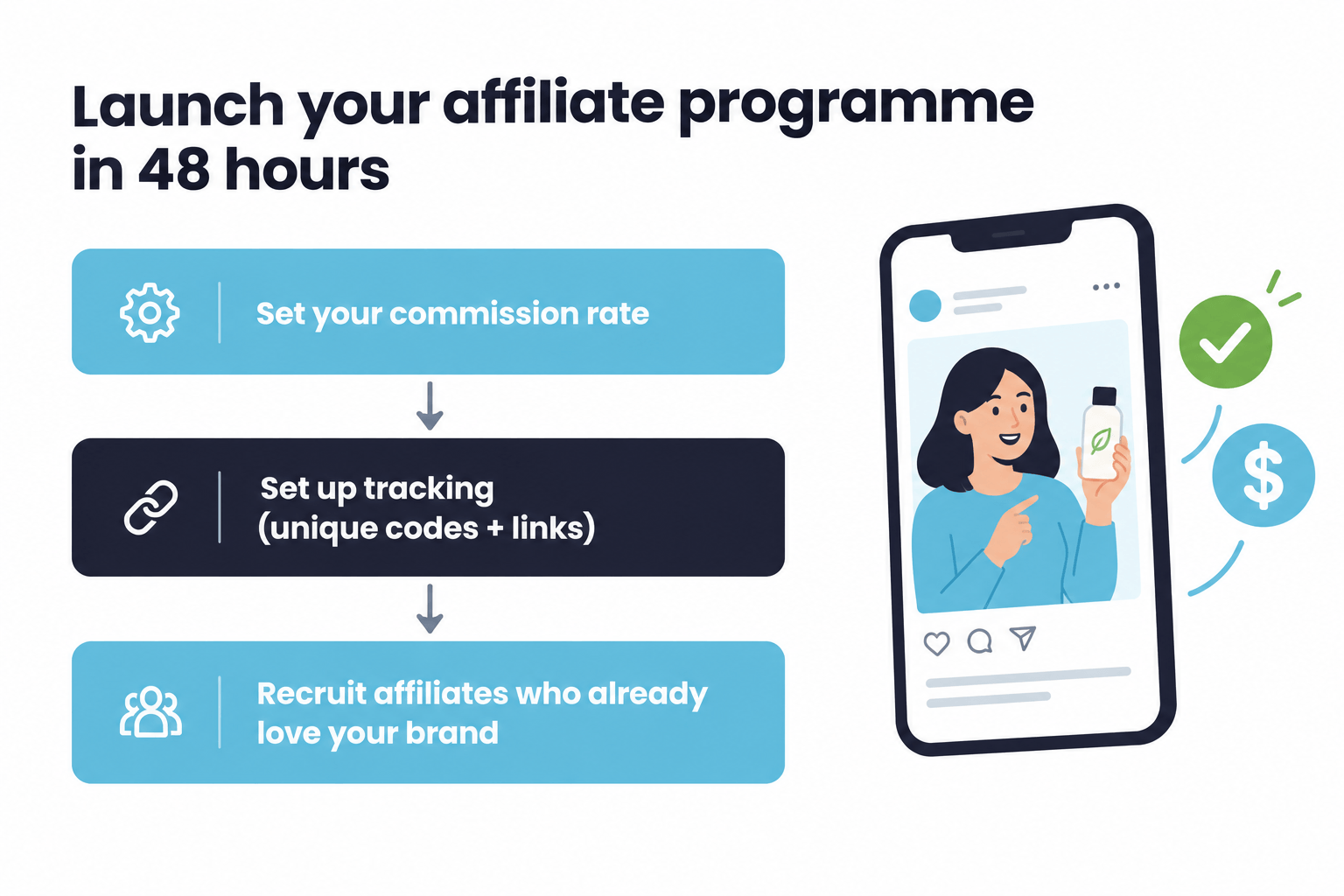
A creator-led launch in five steps
- Shortlist creators: find 20 to 50 micro-influencers whose audiences match your customer profile.
- Gift first: send your hero product instead of paying per post. Our guide to gifted influencer campaigns in Australia covers product costs and outcomes.
- Track every sale: give each creator a unique discount code. Our guide to Shopify influencer discount codes explains the set-up.
- Reuse the content: with permission, add creator photos and videos to product pages, emails, and ads.
- Move the best creators to commission: offer affiliate commission to the creators who drive sales, so their income grows with yours.
This is how Sole Sox, an Australian baby shoe brand, worked with 127 creators to publish 186 pieces of content and generate $10,000 in sales at a 6.5x return on ad spend through gifted and affiliate campaigns on Referwo. For a small brand, that volume of content and social proof would be very hard to create in-house.
Social followers are useful, but you do not own them. Email and SMS lists are channels you control. Offer a welcome discount for signing up, then send a short welcome series that tells your brand story and shows customer reviews. If you want those flows built properly, Elinix AI runs email and SMS marketing for ecommerce brands. For growing your social accounts in parallel, see our guide on how to gain more followers on social media.
Why does customer service decide whether an ecommerce store lasts?
Customer service decides whether an ecommerce store lasts because it drives repeat purchases, reviews, and word of mouth, which are the cheapest sources of new sales. A customer who has a problem solved quickly often becomes more loyal than one who never had a problem. A customer who is ignored tells other people, and online reviews make that visible to every future buyer.
- Answer emails and messages within one business day, and faster during launches.
- Tell customers about delays before they have to ask.
- Make returns simple and consistent with the consumer guarantees.
- Ask every happy customer for a review, with a photo if possible.
- Treat creators as customers too: their unboxing experience is filmed and shared.
Service and marketing are closely linked in ecommerce. Creators notice slow replies, messy packaging, and confusing discount codes, and their audiences notice too. Our guide to how influencer marketing builds ecommerce brand trust covers how service and social proof work together.
What does a 90-day ecommerce launch plan look like?
A realistic 90-day launch plan spends the first month validating the niche and sourcing, the second month setting up the business and store, and the third month launching with creators and measuring results. The timeline stretches if you manufacture your own product, because samples and production runs take longer than building a store.
| Timeframe | Focus | Done when |
|---|---|---|
| Days 1 to 30 | Niche research, supplier samples, landed-cost pricing | You have a tested product, a supplier, and a margin that works |
| Days 31 to 60 | ABN and business name, store build, payments, shipping, returns policy | A friend can buy a product and receive it without help |
| Days 61 to 90 | Creator seeding, email capture, first reviews, reorder planning | You know which creators and channels drive sales |
What mistakes sink new ecommerce businesses?
The mistakes that sink new ecommerce businesses are usually about money and attention rather than technology: pricing without landed cost, ordering too much stock, launching with no marketing plan, and ignoring customers after the sale. Each one is avoidable if you plan for it before launch.
- Pricing from the supplier quote: freight, GST, fees, and returns can turn a healthy-looking margin into a loss.
- Ordering too much stock too early: test with a small batch before committing cash to a full range.
- Building the store before testing demand: weeks of design work cannot rescue a product nobody wants.
- No launch plan for traffic: a new store with no creators, email list, or ads gets almost no visitors.
- Misleading promotion: undisclosed influencer posts and exaggerated claims break the Australian Consumer Law.
Frequently asked questions
How much does it cost to start an ecommerce business in Australia?
It depends mostly on your business model. Dropshipping can start with little more than a store subscription and a domain, because you hold no stock. An own-brand business needs money for samples, a first production run, packaging, and freight before the first sale. Budget separately for marketing, such as gifting product to creators, because a store with no traffic makes no sales.
Do I need an ABN to sell online in Australia?
If you are running an ecommerce business rather than selling the occasional personal item, you should register for an Australian business number (ABN). The ATO requires an ABN before you can register for GST, and you must register for GST within 21 days once your GST turnover reaches $75,000 or more. Check your situation with the ATO or an accountant.
Which is better for a new store: dropshipping or my own brand?
Dropshipping is cheaper and faster to start, but margins are thin, delivery times are harder to control, and many stores sell identical products. An own brand costs more upfront and takes longer, but gives you higher margins, control over quality, and a product that creators and customers can recommend by name. Many founders test demand with a small batch before committing to a full own-brand range.
Which ecommerce platform should an Australian small business use?
Shopify and WooCommerce are the most common starting points for Australian small businesses. Shopify is hosted and quicker to launch; WooCommerce runs on WordPress and gives more control if you already have a WordPress site. Choose the platform that supports your payment methods, shipping rules, and the marketing tools you plan to use, including discount codes for creators.
Do Australian consumer guarantees apply to online stores?
Yes. The ACCC states that online businesses must follow the same consumer laws as physical stores, including the consumer guarantees. That applies to overseas businesses selling directly to Australian consumers too. Your returns and refunds policy must not suggest customers have fewer rights than the Australian Consumer Law gives them.
How do new ecommerce brands get their first customers?
The fastest route for most small brands is a mix of creator seeding and owned channels. Gift your product to 20 to 50 micro-influencers whose audiences match your customers, give each a unique discount code, and capture every visitor’s email with a welcome offer. The creator content also becomes social proof for your product pages and ads.
How does Referwo help new ecommerce brands?
Referwo is an influencer marketing platform for ecommerce brands. Creators apply to your gifted, affiliate, or paid campaigns, you approve the ones who fit, and each receives a unique discount code and tracking link. The dashboard shows posts, clicks, and sales per creator, so a new brand can see which creators actually drive revenue before spending more.
The bottom line
The nuts and bolts of ecommerce have not changed much: sell something people want, at a price that covers your true costs, and look after every customer. What has changed is how customers find new brands. The stores that grow fastest plan their marketing engine alongside the store, and put their product in front of creators and customers who will recommend it.
If you are ready to launch with creators applying to promote your products, and every sale tracked back to the creator who drove it, see how Referwo works for Australian ecommerce brands.

Sources
- Australian Bureau of Statistics, Retail Trade, Australia, June 2025
- Australian Taxation Office, Registering for GST
- Australian Taxation Office, GST on low value imported goods
- Australian Border Force, GST and other taxes when importing
- ACCC, Selling online
About the author: Ewen Ling is the co-founder of Referwo and an ecommerce entrepreneur with 16 years of hands-on experience. He co-founded Elinz Electronics in 2005 and scaled it into a fully operational business before managing a successful exit for shareholders in 2021. At Referwo, Ewen helps ecommerce brands build influencer marketing programmes that generate measurable revenue, not just reach.