


By Ewen Ling, Co-Founder, Referwo | Ecommerce Growth Strategist
Last updated: September 2026
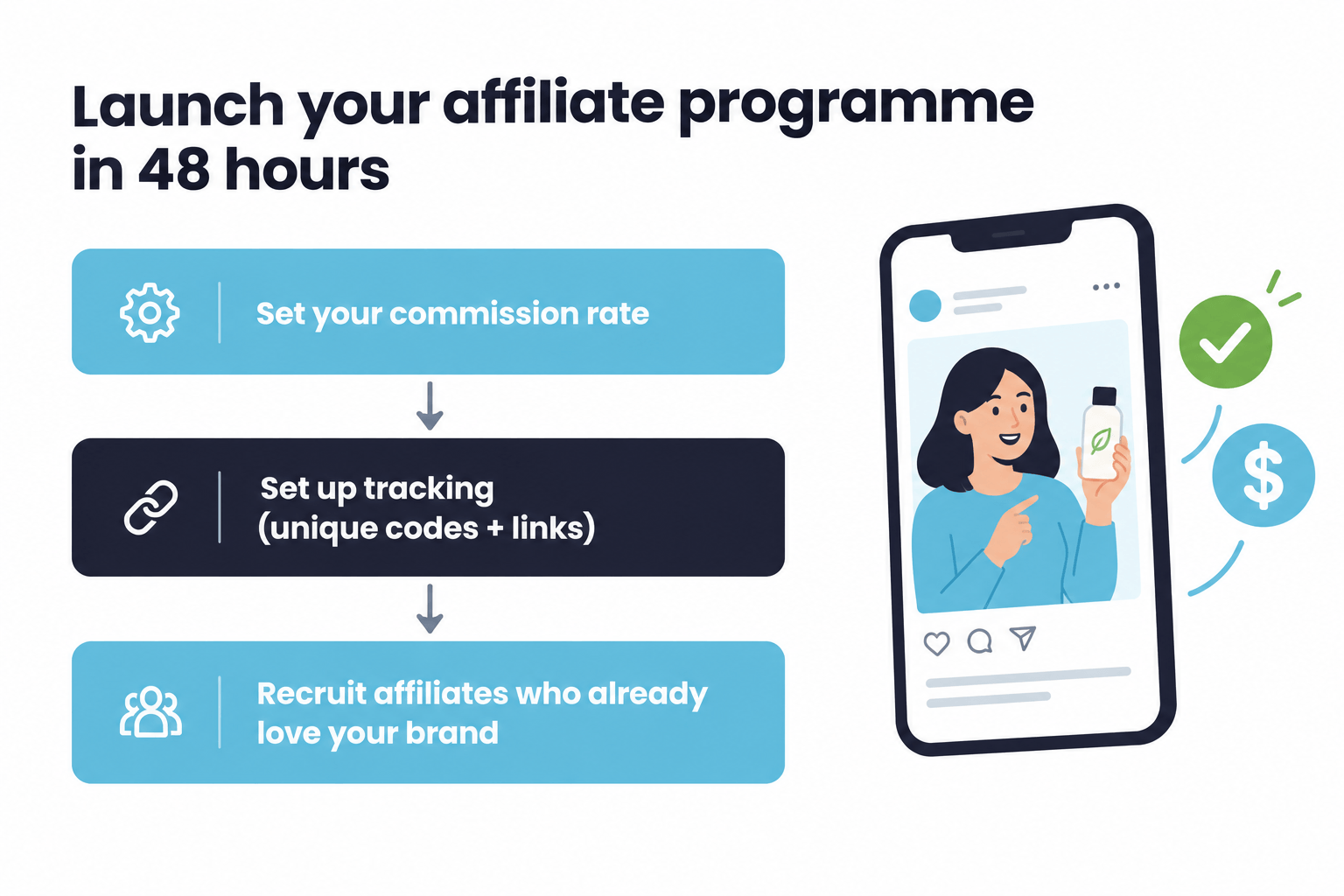
Starting an affiliate programme for your Australian Shopify store comes down to three decisions, what commission rate to offer, how you will track which sales each affiliate drives, and where you will find affiliates who already match your audience. Most brands can have their first programme live within 48 hours.
Running cold outreach to creators, negotiating rates over email, and guessing at ROI in a spreadsheet, that is what most Australian Shopify brands do when they first try influencer or affiliate marketing. It is also why most of them stop. A properly set-up affiliate programme replaces all of that. Affiliates apply to work with you. Every sale they drive is tracked automatically. You pay commission only when a purchase happens. No upfront media spend, no guaranteed payments for content that might never get posted.
If you want to run affiliates alongside an influencer gifting strategy, our guide to launching an influencer gifting campaign in Australia covers how the two models combine. Here is what you need to build the affiliate side from scratch.
Quick Answer
Starting an affiliate programme for your Shopify store requires three decisions: commission rate (15–20% for beauty, 10–15% for fashion), tracking method (unique links and discount codes), and affiliate recruitment (your existing customers, social channels, or a platform like Referwo). Most Australian Shopify brands can be live within 48 hours. You pay commission only on confirmed sales – no upfront spend required.
What does an affiliate programme cost a Shopify store to run?
Before you set a commission rate, it helps to understand the full cost picture. Affiliate programmes are often described as low-cost because you only pay on performance. That is true for the commission itself, but there are three cost buckets to plan for.
- Software costs: For Australian Shopify brands running an affiliate programme properly, Referwo is the purpose-built platform, connecting your Shopify store to a vetted creator network, issuing each creator a unique discount code and referral link, tracking every sale in real time, managing commission payouts, and keeping your programme automated as it scales. Starting from USD 69/month, most Australian brands running 20 or more affiliates find the time saved on admin worth the subscription. Shopify also includes some built-in tool, discount code creation and Shopify Collabs, which cover basic tracking for programmes with fewer than 10–15 affiliates at no additional software cost. That works as a starting point, but manual code management and payment tracking becomes a real bottleneck as your programme grows.
- Product cost for gifted affiliates: Most affiliate programmes combine commission with an initial gifted product, particularly for new affiliates who have not promoted your brand before. A skincare or beauty brand gifting a $40 hero product to 50 affiliates has a $2,000 upfront product cost before a single sale happens. A homewares brand gifting a $120 item to the same 50 affiliates carries a $6,000 product cost.
- Commission as a variable cost: Commission is paid only on confirmed sales, which is why it sits in your cost-of-goods-sold rather than your fixed marketing budget. The key is setting a rate that makes affiliates genuinely motivated to promote while still leaving margin for your business. At a 15% commission rate on a $60 product, you pay $9 per sale. If that affiliate drove 10 sales this month, the commission is $90. If they drive zero, you pay nothing.
Commission rates by product category in Australia
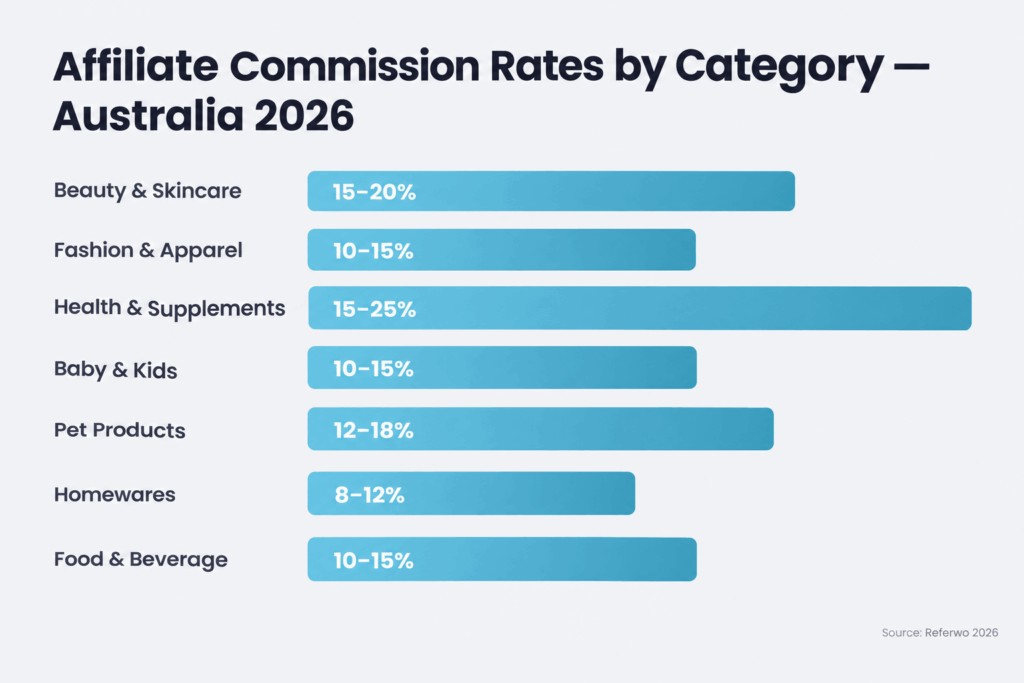
Commission rates vary meaningfully by product category because the profit margins, conversion rates, and promotion effort involved differ significantly. The benchmarks below reflect current Australian ecommerce practice across affiliate and creator programmes.
| Product category | Typical commission range | Notes |
|---|---|---|
| Beauty and skincare | 15% – 20% | High repeat purchase rate supports stronger commission |
| Fashion and apparel | 10% – 15% | Higher return rates; stay toward lower end of range |
| Health and supplements | 15% – 25% | Subscription products justify higher rates |
| Baby and kids products | 10% – 15% | Trust-driven category; authenticity matters more than rate |
| Pet products | 12% – 18% | Passionate audience with strong repeat purchase behaviour |
| Homewares and lifestyle | 8% – 12% | Longer buying cycles; lower margins often limit rate |
| Food and beverage | 10% – 15% | Works well with bundle gifting to drive trial |
One practical rule: if your margin does not comfortably support the commission at your category’s lower end, look at your pricing before you look at your affiliate strategy. A programme that leaves you underwater on commission is not sustainable. Our guide to influencer marketing costs and budgeting covers the full financial picture in more detail.
How to track affiliate sales without spreadsheets
Tracking affiliate sales manually, checking each month how many times each discount code was used, works until it does not. Once you have more than 10 affiliates, the administrative overhead becomes the biggest barrier to growing your programme. Here is how tracking actually works.
Shopify’s native tracking (discount codes only):
Shopify lets you create unique discount codes per affiliate and pull order reports filtered by discount code. This tells you how many sales were made using each code. It does not capture purchases made by people who saw an affiliate’s content but bought later without using the code, a common pattern in categories with a longer consideration period.
Referwo’s tracking (unique discount codes and referral links):
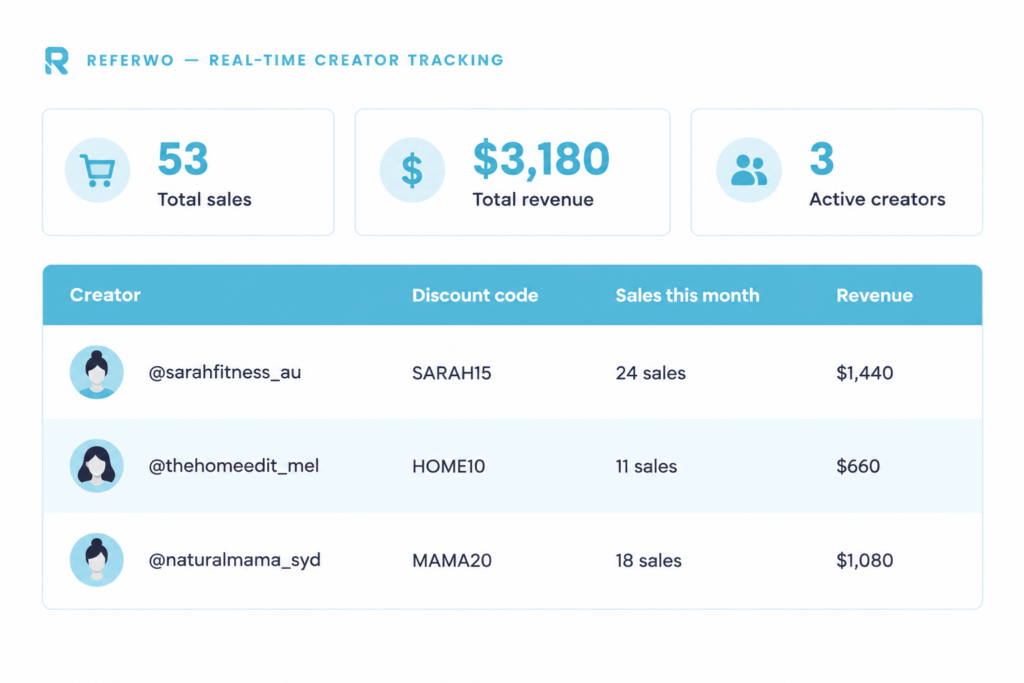
On Referwo, every affiliate gets a unique discount code and a unique tracking link. The discount code does the heavy lifting. Instagram does not allow clickable links in posts, reels, or captions, so most of an influencer’s audience never clicks through, they see the content, remember the code, and use it at checkout. That code is how the sale gets tracked back to the creator who drove it. To make the code easy to find, creators add their Dealshub storefront to their link in bio, where followers can see every discount code that creator holds and shop directly. The tracking link covers the remainder for creators sharing in stories or their bio. Both feed the same Referwo dashboard, so you see sales, clicks, and revenue per creator in real time.
Where to find affiliates who already like your product
The best affiliates are people who would post about your product regardless of commission, because they genuinely use and like it. Recruiting from that pool produces more authentic content and better conversion rates than recruiting from a cold list of creators looking for brand deals.
- Your existing customers: Search your order history for repeat buyers who have a social presence. A customer who has ordered from you three times and posts lifestyle content is already a de facto brand advocate, formalising that relationship with an affiliate offer is a low-friction task that converts well.
- Social tags and mentions: Check who is already tagging your brand on Instagram or TikTok. People who post about your product without being paid are your highest-signal affiliate prospects. Send a direct message with a personalised affiliate invite, not a templated pitch.
- An inbound affiliate programme: A signup page on your website or a listing on a platform like Referwo lets creators find you rather than you hunting them. On Referwo, creators apply to your campaign, you review, approve, and they receive their unique link and discount code automatically. The inbound model scales without proportional outreach effort. See our guide on how to find micro-influencers for a practical framework for identifying the right creator profile for your brand.
Affiliate vs influencer marketing: when each one works
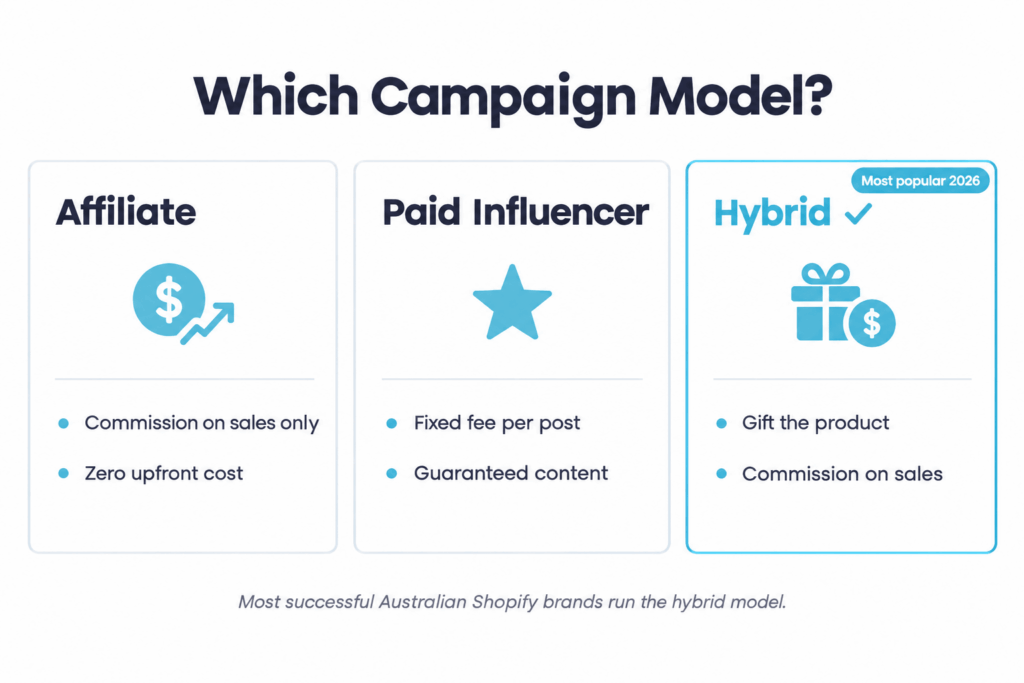
Affiliate and influencer marketing are often treated as two separate channels, but for most Australian Shopify brands they work best as one hybrid strategy. Understanding the difference helps you deploy each correctly.
| Model | How payment works | Best for |
|---|---|---|
| Affiliate | Commission on sales only – zero upfront cost | Performance tracking, scalable programmes, lower-risk first campaigns |
| Influencer (paid) | Fixed rate per post or campaign, regardless of sales | Product launches, brand awareness, guaranteed content delivery |
| Hybrid (gifting + commission) | Product gifted; commission earned on sales generated | Building creator relationships while keeping performance accountability |
The hybrid model – gift a product, add a commission structure, is what most successful Australian Shopify brands are running in 2026. The gifting covers the brand awareness and content creation side; the commission aligns creator incentives with your sales outcomes. For a full breakdown of how these models compare, see our guide to affiliate vs gifted vs paid influencer campaigns. For a detailed comparison of your platform options, see our Shopify Collabs vs Referwo comparison.
Frequently asked questions
Do I need a separate app to run an affiliate programme on Shopify?
Not to get started. Shopify’s native discount code system lets you create unique codes per affiliate and track redemptions through your order reports. This works for programmes with fewer than 10–15 affiliates. Once you grow beyond that, a dedicated platform like Referwo automates commission tracking, payment, and affiliate communication, saving significant time and improving creator accountability.
What is a good affiliate commission rate for an Australian ecommerce brand?
It depends on your category. Beauty and skincare brands typically offer 15–20%, fashion 10–15%, and health or supplement brands 15–25%. The rate needs to be high enough to genuinely motivate promotion while still leaving a viable margin. If your margin can’t comfortably support the lower end of your category’s benchmark, revisit your pricing before launching.
How do I pay affiliates in Australia?
Payment methods vary. Dedicated platforms like Referwo automate commission tracking and pay affiliates when they hit a minimum threshold, typically via direct bank transfer or PayPal. Manual payment via PayPal or bank transfer is also common for smaller programmes.
Do Australian influencer affiliates need to disclose their commission arrangement?
Yes. Under Australian Consumer Law and the AANA Code of Ethics, any commercial arrangement, including affiliate commission – creates a disclosure obligation. A clear label such as #ad or “Paid partnership” is required whenever a creator promotes a brand they receive payment or commission from.
How many affiliates do I need to see meaningful results?
Ten well-matched affiliates who actively promote will outperform 100 who received a product and went quiet. Running 15–30 active affiliates gives you enough data to identify your top performers and invest more in those relationships over time.
What is the difference between an affiliate and an influencer?
An affiliate earns commission only when they drive a confirmed sale, performance-based payment with no guaranteed earnings. An influencer is typically paid a fixed fee for content creation and posting, regardless of how many sales result. Many modern campaigns combine both: the creator is gifted a product and earns a commission on any sales they generate.
Should I gift a product to affiliates before they start promoting?
For most categories, yes. An affiliate who has actually used your product creates more credible and persuasive content. Gifting a hero product before expecting promotion also sets a professional tone for the relationship and increases the likelihood of genuine, high-quality posts.
Can nano-influencers be effective affiliates for my Shopify store?
Yes, often more effective than larger creators on a cost-per-sale basis. Nano-influencers (1,000–10,000 followers) typically have highly engaged niche audiences and strong personal credibility with their followers. Their conversion rates on affiliate codes frequently outperform those of accounts with 10x the following.
How long does it take to set up an affiliate programme on Shopify?
A basic affiliate programme using Shopify’s native discount code system can be set up in a few hours. On Referwo, most brands have their first campaign live within 24–48 hours of connecting their Shopify store.
What should I include in an affiliate agreement?
At minimum: commission rate and payment schedule, tracking method (unique link and/or code), disclosure requirements (under ACCC/AANA rules), prohibited claims, and the brand’s right to terminate the arrangement. Keeping terms clear upfront prevents disputes and sets professional expectations from day one.
What is a cookie window in affiliate marketing?
A cookie window is the period during which a sale is credited to an affiliate after someone clicks their tracking link. A 30-day cookie window means that if a person clicks an affiliate’s link and purchases within 30 days, the affiliate earns commission on that sale, even if they didn’t purchase immediately.
How is Referwo different from a standard Shopify affiliate app?
Referwo combines influencer gifting, affiliate tracking, and commission payments in one platform built specifically for Australian brands. Unlike generic Shopify affiliate apps, Referwo includes a creator marketplace where Australian creators can discover and apply to your campaign, built-in disclosure compliance features aligned with ACCC and AANA requirements, and real-time per-creator reporting, so you can see exactly which affiliates are generating revenue and scale accordingly.
The bottom line
An affiliate programme for your Australian Shopify store is one of the most cost-efficient marketing channels available, because you pay only when a sale actually happens. The setup is straightforward: set a commission rate that works for your category, choose a tracking method that gives you real attribution data, and recruit affiliates from the pool of people who already have a reason to believe in your product.
If you want to run affiliates and influencer gifting in one place, with automated tracking, commission payments, and built-in disclosure compliance, explore how Referwo works for Australian brands. Most brands are live within 48 hours.
About the author: Ewen Ling is the co-founder of Referwo and an ecommerce entrepreneur with 16 years of hands-on experience. He co-founded Elinz Electronics in 2005 and scaled it into a fully operational business before managing a successful exit for shareholders in 2021. At Referwo, Ewen helps ecommerce brands build influencer marketing programmes that generate measurable revenue, not just reach.