


Updated July 2026| 10 min read | By Referwo
Quick answer:
As of July 2026, Australian influencer marketing typically costs: gifted campaigns – product cost only (roughly USD 20-290 depending on tier); affiliate campaigns – 10-20% commission per sale, nothing if nothing sells; paid campaigns – roughly USD 20-200 per post for nano/micro creators up to USD 5,000-20,000+ for macro creators, varying by platform.
| Influencer Tier | Gifted (product cost) | Affiliate (commission) | Paid (per post) |
| Nano (1K-10K followers) | USD 20-50 | 10-20% of sale value | USD 20-200 |
| Micro (10K-100K followers) | USD 30-100 | 10-20% of sale value | USD 100-2,000 |
| Mid-Tier (100K-500K followers) | USD 65-195 | 10-20% of sale value | USD 1,500-8,000 |
| Macro (500K-1M followers) | USD 130-290 | 10-20% of sale value | USD 5,000-20,000+ |
Rates as of July 2026. All figures in USD. Paid figures from industry benchmarks (Influencer Marketing Hub, Collabstr 2025 Influencer Marketing Report). Gifted figures are illustrative product-cost ranges.
How much does an influencer marketing platform cost in Australia?
Influencer marketing platforms in Australia range from free to several hundred US dollars a month. Self-serve discovery and campaign tools typically cost USD 69 to 499 a month, managed services start around USD 399 a month, and enterprise plans are quoted. Referwo starts at USD 69 a month with a 14-day free trial. Creator fees sit on top.
| Platform | Plan | Price (USD) | Notes |
| Referwo | Basic | 69 / month | 14-day free trial. 3 active campaigns, 50 creator applications a month |
| Referwo | Standard | 99 / month | 14-day free trial. 9 active campaigns, 500 creator applications a month |
| Referwo | Premium | 399 / month | Fully managed by the Referwo team. No free trial |
| Modash | Essentials / Performance | 199 / 499 a month | Creator discovery and tracking. 14-day free trial. Enterprise from USD 14,700 a year |
| Heepsy | Starter / Plus / Advanced | 89 / 199 / 299 a month | Creator search tool. Free plan available. About 25% less on annual billing. Heepsy shows prices in $ without naming the currency |
| Shopify Collabs | For Shopify merchants | Free to install | 2.9% processing fee on commission payments to creators. Requires an eligible Shopify plan |
Public list prices checked on 7 October 2026 on each platform’s pricing page. Prices are in USD, billed monthly unless noted, and exclude creator fees, product costs and GST. TRIBE does not publish its prices.
Real Referwo Campaign Results
Thread the Word (Australian custom baby blanket brand): activated 174 influencers through Referwo and generated AUD 59,547 in sales, with 746% ROI and 8.5x ROAS.
Cherub Baby: activated 119 influencers through Referwo and drove AUD 34,855 in sales with 1,062% ROI and 11.6x ROAS. Full case study: referwo.com/case-studies/cherub-baby
How much should you expect to pay for influencer marketing campaigns? The short answer: anywhere from USD 20 to 20,000+ per post, depending on who you partner with, which platform you use, and how you structure the collaboration. But that range isn’t very helpful on its own. What you actually need is a framework for understanding what drives those costs, and how to get the best return on your investment.
In this guide, we break down influencer marketing costs by tier, platform, and campaign type, so you can build a realistic budget and stop leaving money on the table.
Why Influencer Marketing Costs Vary So Much
Unlike Facebook Ads or Google PPC, there is no fixed rate card for influencer marketing. Two creators in the same niche, with similar follower counts, can quote you completely different prices. That is not a quirk — it is a feature of a market driven by multiple overlapping factors.
The main variables that determine how much you will pay include:
- Influencer tier (nano, micro, mid-tier, macro, celebrity)
- Platform (Instagram, TikTok, YouTube, Facebook)
- Content format (static post, Reel, Story, long-form video)
- Campaign type (gifted, affiliate, or paid collaboration)
- Niche and audience quality
- Usage rights and content licensing
- Exclusivity requirements
Understanding these levers is the foundation of smart influencer budgeting.
Influencer Pricing by Tier: What the Numbers Look Like in 2026
The most commonly used way to estimate influencer costs is by follower count, often called influencer tier. Here is a breakdown of typical rates:
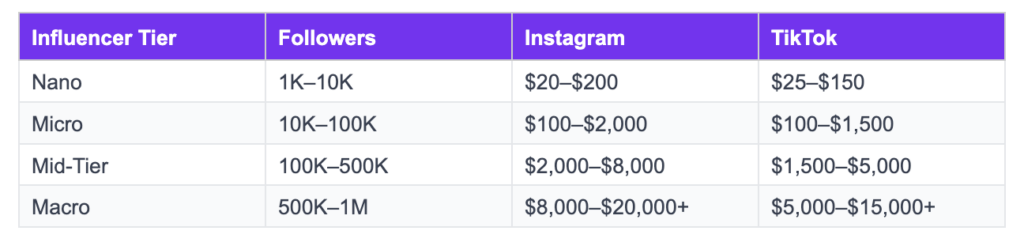
Source: Influencer Marketing Hub, Collabstr 2025 Influencer Marketing Report
It is important to note these are per-post estimates for a single piece of content. A typical campaign involves multiple content pieces, and if you add usage rights, exclusivity, or paid amplification, costs increase further.
 Important: Follower count alone does not determine value. A nano-influencer with 5,000 highly engaged followers in the baby products niche can outperform a macro-influencer with 500,000 passive followers — at a fraction of the cost. Important: Follower count alone does not determine value. A nano-influencer with 5,000 highly engaged followers in the baby products niche can outperform a macro-influencer with 500,000 passive followers — at a fraction of the cost. |
Platform-by-Platform Cost Breakdown
Where your influencer posts matters just as much as who they are. Here is what brands are typically paying by platform in 2025–2026:
- Single post (nano): USD 20–200
- Single Reel (micro): USD 300–2,000
- Instagram Stories: USD 50–1,200 per set
Instagram remains the dominant platform for influencer campaigns, particularly in lifestyle, beauty, parenting, and food niches. Reels command the highest rates due to their reach and production value.
TikTok
- Nano-influencer post: USD 25–150
- Micro-influencer video: USD 100–1,500
- Mid-tier sponsored video: USD 1,500–5,000+
TikTok is the fastest-growing platform for product discovery. According to Collabstr’s 2025 Influencer Marketing Report, brands pay around USD 350 per collaboration on average, comparable to Instagram, though nano and micro-influencer rates can offer stronger value due to TikTok’s algorithm-driven reach.
YouTube
- Short-form video (under 60 seconds): USD 500–2,000
- Mid-length sponsored segment: USD 2,000–10,000
- Dedicated long-form review: USD 5,000–30,000+
YouTube sits at the premium end of influencer pricing. Production requirements are higher, and the content tends to have longer shelf life, which justifies the cost for brands where in-depth product reviews drive conversions.
Facebook influencer posts range from USD 25 (nano) to USD 6,000+ (macro), but the platform sees lower influencer marketing activity compared to Instagram and TikTok. It remains relevant for older demographics and community-led niches.
The Three Campaign Types and What Each One Costs
One of the most impactful decisions you will make for your budget is choosing your campaign type. To determine which campaign type fits your budget, you need to weigh upfront costs against your specific growth goals.
1. Gifted Campaigns: Lower Upfront Cost, High Content Volume
With gifted campaigns, you send influencers a free product in exchange for content and social exposure. There is no cash fee. Your main costs are:
- Product cost (cost of goods)
- Shipping and fulfilment
- Platform subscription (e.g., Referwo from USD 69/month)
Gifted campaigns are ideal for brands looking to generate high-quality UGC at scale without large cash outlays. They work best when your product is genuinely compelling and your brief is clear.
2. Affiliate Campaigns: Pay Only for Sales Generated
Affiliate campaigns let you pay influencers a commission on every sale they drive, tracked through unique discount codes. Your costs are:
- Commission rate (typically 10–20% of sale value)
- Discount code value (if offering a customer incentive)
- Platform subscription
This is as close to risk-free influencer marketing as you can get. If no sales are made, you pay nothing in commission. Available for Shopify and WooCommerce stores on Referwo.
For a deeper look at how this compares, see our blog: Affiliate vs. Gifted vs. Paid Influencer Campaigns
3. Paid Collaborations: Maximum Control, Higher Spend
Paid campaigns involve a direct cash fee to the influencer for creating and posting content. Rates follow the tier and platform breakdowns above. You gain:
- Greater creative control over content
- Ability to work with larger, higher-reach creators
- Content usage rights (negotiate upfront)
Paid campaigns require the most budget but deliver the most predictable output. They work well when brand awareness is the primary goal and you need consistent, high-quality creative at scale.
Pro tip: Many brands on Referwo combine campaign types simultaneously, running gifted campaigns for volume and content, while using affiliate campaigns to convert sales. This hybrid approach typically delivers the highest overall ROI. Learn more in our guide on how to develop an effective influencer marketing strategy.
Hidden Costs Brands Often Miss
Beyond the per-post rate, several additional costs can significantly affect your total campaign spend if you are not planning for them:
Content Usage Rights
If you want to repurpose influencer content in your own ads, website, or email marketing, you will typically need to pay for licensing. A general rule is to add 50–100% of the original post fee for extended usage rights. Always negotiate this upfront. More on this in our blog: Harnessing the Power of UGC in Influencer Marketing Campaigns.
Exclusivity Clauses
Asking an influencer not to work with competing brands during or after your campaign will cost extra, typically 25–50% on top of their base rate, depending on the restriction period.
Seasonal Rate Spikes
Rates typically spike 20–30% during peak shopping periods like Black Friday, the holiday season, and back-to-school campaigns. If your product is seasonal, plan campaigns in the lead-up period to avoid the premium. This applies especially to product seeding strategies where influencers need time to test and create content.
Agency Fees
Working with a traditional influencer marketing agency typically costs USD 2,000–20,000+ per month in management fees on top of influencer payments. This is one of the biggest cost drivers for brands running campaigns without a dedicated platform. For a detailed breakdown, see our guide: How Influencer Marketing Agencies Work: Costs, Services & What to Expect.
What Should Your Influencer Marketing Budget Actually Be?
There is no single ‘right’ answer, but here is a practical framework depending on where your business is:
Startup / Early-Stage Brands
- Recommended approach: Gifted campaigns only
- Estimated monthly budget: USD 500–2,000 (product costs + shipping)
- Platform subscription: From USD 69/month
- Focus: Building UGC, social proof, and brand awareness
Growing E-commerce Brands
- Recommended approach: Gifted + affiliate campaigns
- Estimated monthly budget: USD 2,000–8,000
- Focus: Trackable conversions alongside content volume
Thread the Word, an Australian custom baby blanket brand, activated 174 influencers through Referwo using this approach and generated AUD 59,547 in sales, with a 746% ROI and 8.5x ROAS. Read the full case study →
Established Brands Scaling Up
- Recommended approach: Gifted + affiliate + paid collaborations
- Estimated monthly budget: USD 8,000–30,000+
- Focus: Brand recognition, high-reach content, and sustained revenue growth
| If budget is a constraint but you still want scale, micro and nano-influencers consistently deliver stronger ROI per dollar than macro-creators. Cherub Baby activated 119 influencers through Referwo and drove AUD 34,855 in sales with 1,062% ROI and 11.6x ROAS. See the full results: referwo.com/case-studies/cherub-baby |

How to Measure ROI So You Know Every Dollar Is Working
Budgeting without measurement is guesswork. The brands getting the best returns are those tracking ROI across affiliate and gifted campaigns to see which creators drive real revenue versus just views.
Key metrics to monitor:
- Discount code redemptions per influencer
- Affiliate sales attributed per creator
- Content engagement rates (likes, comments, shares)
- Reach and impressions
- Website traffic spikes correlated with campaign activity
Referwo’s dashboard tracks all of this automatically, so you can see which influencers are driving actual sales vs. just views. For more on measuring performance, read: How to Track ROI from Influencer Marketing (with Real Stats).
You should also review our guide on Understanding Influencer Tiers: Choosing the Right Influencer for Your Campaign to ensure the creators you are investing in are genuinely aligned with your target audience.

How Referwo Helps You Get More From Your Influencer Budget
One of the biggest inefficiencies in influencer marketing is time. Brands spend hours on manual outreach, spreadsheet tracking, and chasing payments, all of which adds an invisible cost to every campaign. Referwo automates the heavy lifting, so your budget goes towards results, not admin.
Here is what the platform handles for you:
- Influencers apply to your campaign, no cold outreach needed
- Automated product gifting and order processing
- Unique discount code generation and tracking per influencer
- Commission payout automation for affiliate campaigns
- Real-time sales dashboard showing revenue per creator
- Content review and approval in one centralised location
- Influencer Dealshub — ongoing brand visibility beyond campaign periods
Plans start from USD 69/month, with a 14-day free trial. For brands that want a fully managed service, the Premium Plan (from USD 399/month) includes a dedicated account manager handling everything from influencer outreach to content approvals.
See what other brands are achieving: Referwo Case Studies →
Frequently Asked Questions
How much does an influencer marketing platform cost in Australia?
Influencer marketing platforms in Australia range from free to several hundred US dollars a month. Self-serve discovery and campaign tools typically cost USD 69 to 499 a month, managed services start around USD 399 a month, and enterprise plans are quoted. Referwo starts at USD 69 a month with a 14-day free trial. Creator fees sit on top.
How much do influencers charge per post in Australia?
Paid posts in Australia cost roughly USD 20 to 200 for nano creators, USD 100 to 2,000 for micro creators, USD 1,500 to 8,000 for mid-tier creators and USD 5,000 to 20,000 or more for macro creators. Rates vary by platform and format, with Reels and YouTube videos at the top end.
How much does an influencer marketing agency cost?
Traditional influencer marketing agencies typically charge USD 2,000 to 20,000 or more a month in management fees, on top of what you pay the creators. A self-serve platform like Referwo starts at USD 69 a month.
What should a small brand budget for influencer marketing?
Early-stage brands can start with gifted campaigns only, at about USD 500 to 2,000 a month in product and shipping costs, plus a platform subscription from USD 69 a month. Growing brands that add affiliate campaigns typically spend USD 2,000 to 8,000 a month.
Is affiliate influencer marketing cheaper than paid?
Usually, yes. With affiliate campaigns, creators earn a 10 to 20% commission only on the sales they drive, so if nothing sells you pay no commission. Paid collaborations cost a fixed fee regardless of results.
What hidden costs should I budget for in influencer marketing?
Plan for usage rights to reuse content in ads (usually 50 to 100% of the post fee), exclusivity clauses (25 to 50% extra) and seasonal rate spikes of 20 to 30% around Black Friday and the holidays.
Key Takeaways: Budgeting for Influencer Marketing in 2025
- Expect to pay USD 20–200+ per post for nano-influencers and USD 2,000–20,000+ for macro-creators on platforms like Instagram and TikTok.
- Gifted campaigns are the most budget-friendly entry point, your costs are primarily product and shipping.
- Affiliate campaigns offer the best risk-adjusted ROI since you only pay for proven sales.
- Hidden costs like usage rights, exclusivity, and agency fees can significantly inflate your total spend if not planned for.
- Micro and nano-influencers typically deliver higher ROI per dollar than macro-creators for e-commerce brands targeting niche audiences.
- Platforms like Referwo reduce the operational cost of running campaigns by automating outreach, gifting, tracking, and payouts.
Ready to Start Your Influencer Campaign?
Stop guessing what influencer marketing should cost and start building campaigns that are tied to measurable results. Start your free 14-day trial on Referwo and get your first influencer applications within hours — or book a demo to see how the platform works for your brand.
Related reading: Why Influencer Marketing Works (And Why Brands Are Doubling Down on It) | How to Launch an Influencer Gifting Campaign | Performance-Based Influencer Marketing: The Key to Higher ROI in 2025