
By Ewen Ling, Co-Founder, Referwo | Ecommerce Growth Strategist
Last updated: November 2026
Quick answer: Health and wellness brands in Australia use influencer marketing to show real people using foods, drinks and fitness gear, and track each creator’s sales. Supplements regulated as therapeutic goods follow stricter TGA rules: gifted creators can’t give personal-use testimonials about them. Referwo gives each creator a discount code, and plans start at US$69 a month with a 14-day free trial.
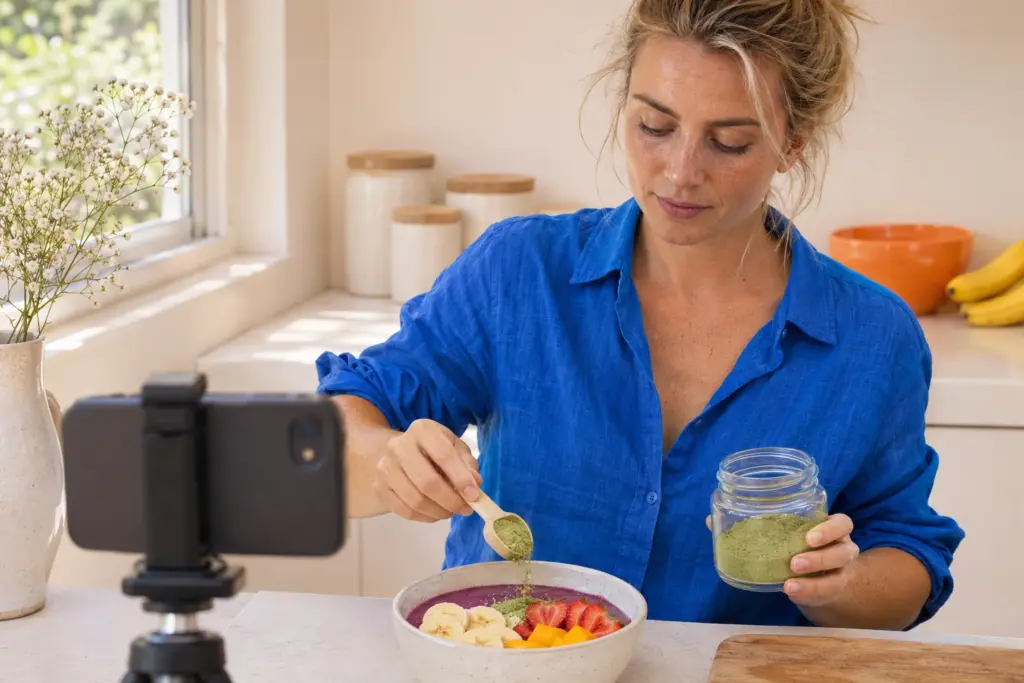
Wellness shoppers buy on trust. Before they try a new greens powder or protein blend, they want to see someone like them use it and keep using it. A creator who adds your superfood mix to a breakfast bowl on camera can show that better than a product photo.
Health and wellness is also a tightly regulated category to promote. A gifted creator can say different things about a breakfast cereal, a vitamin and a foam roller, because each one sits under a different set of rules.
This guide to wellness brand influencer marketing is for health food, supplement and wellness brand owners in Australia who want to run creator campaigns without an agency. It covers which rules apply to your product, what creators can and can’t say, which creators to pick, what to ask them to film, and what it costs. You can see how campaigns run on our platform for brands, and how Morlife, an Australian health food brand, tracked a year-on-year sales lift through creator discount codes.
Key facts
- Morlife, an Australian health food brand, saw an estimated sales increase of $10,800+ compared with the same period the year before, tracked through creator discount codes (Referwo case study).
- Morlife’s creator campaigns reached 250,000+ impressions, 165,000+ views and 90,000+ engagements (Referwo case study).
- Under the Therapeutic Goods Advertising Code, free product, gifts and discounts count as “valuable consideration”, so a gifted creator can’t give a testimonial for a therapeutic good in an ad (TGA guidance, June 2022).
- Food businesses must follow Standard 1.2.7 for health claims on labels, in advertisements and in endorsements (Getting Your Claims Right, Food Regulation Standing Committee, 2018).
How do health and wellness brands use influencer marketing?
Health and wellness brands use influencer marketing to show their products inside real routines: a smoothie in the morning, a snack after training, a tea before bed. Creators who already post about food, fitness or self-care share the product with followers who care about the same things. A unique discount code for each creator shows which creators drive sales and which mainly bring reach.
Wellness products also suit repeat buying. A tub of protein runs out. A snack bar becomes a weekly habit. Each restock gives a creator an honest reason to post again, to the same followers, weeks after the first video.
That repeat pattern is why wellness brands love using Referwo to build a community of creators around their brand. Every campaign adds creators to your community. The ones who love your product come back, post again and bring their followers with them, and every sale through their code stays tracked.
Morlife’s case study page describes creators sharing recipes and lifestyle tips around the brand’s seasonal superfood blends. A recipe gives the creator something useful to post and shows followers how to use the product.
Is your product a food, a therapeutic good or a general product?
The rules a creator must follow depend on what your product legally is. Products classified as foods, such as many protein powders and snack bars, follow the Food Standards Code for health and nutrition claims. Therapeutic goods, such as vitamins, herbal supplements and some topical products, follow the Therapeutic Goods Administration (TGA) advertising code. General products, such as yoga mats or water bottles, mainly follow Australian Consumer Law.
Work this out before you write a brief. The same sentence from a creator can be fine for one product and a breach for another.
| Product type | Examples | Main rules | What it means for a creator post |
|---|---|---|---|
| Food | Superfood blends, protein powder, snack bars, teas | Australian Consumer Law and the Food Standards Code (Standard 1.2.7) | Health claims must follow the approved rules for food claims |
| Therapeutic good | Vitamins, minerals, herbal supplements, some sunscreens and muscle rubs | Australian Consumer Law and the TGA advertising code | A gifted or paid creator can’t give a personal testimonial in an ad |
| General product | Yoga mats, foam rollers, drink bottles, activewear | Australian Consumer Law | Label the post as an ad and keep claims true |
A quick first check: medicines listed or registered with the TGA carry an AUST L, AUST L(A) or AUST R number on the label. A missing number doesn’t prove a product is outside the TGA’s rules, though. Some sports supplements count as therapeutic goods, for example when they make performance claims and come as a tablet, capsule or pill. If you are not sure which group your product falls into, ask a regulatory adviser before the campaign starts.
Whatever the product, Australian Consumer Law applies. A post a creator makes in return for free product or payment must be clearly labelled as advertising, for example with #ad. In its December 2023 review, the ACCC found 81% of 118 influencers reviewed made posts that raised concerns, and not disclosing a brand relationship was the most common issue. Our guide to influencer gifting rules in Australia covers the labels that work.
What can gifted creators say about supplements and therapeutic goods?
Gifted or paid creators can’t give testimonials about therapeutic goods in advertising. A testimonial is a statement from someone who says they used the product, such as “this magnesium helped me sleep”. The TGA counts free product, gifts and discounts as “valuable consideration”, so a creator who received your vitamins for free is treated as part of your marketing.
The rule comes from section 24 of the Therapeutic Goods Advertising Code 2021. The TGA’s guidance on testimonials and endorsements gives a worked example of a health blogger who gets a free six-month supply on the condition of a testimonial. The guidance says his testimonial must not be used in the product’s ads. The ban applies even if the payment is disclosed and the creator genuinely likes the product.
Endorsements are different from testimonials
First, check the product can be advertised to the public at all. Prescription-only medicines, for example, can’t be. If it can, the same TGA guidance says a paid creator can still endorse a therapeutic good, as long as the creator is not in an excluded group. An endorsement supports the product without a personal-use story. For example, “this muscle rub is made to rub in easily and isn’t sticky” describes the product. “I rub it in after training and it eases my sore muscles” is a testimonial.
Who can’t endorse therapeutic goods at all
Section 24(6) of the code lists people who must not endorse therapeutic goods. For wellness brands, the groups to watch are:
- Health professionals: current or former health practitioners, health professionals and medical researchers.
- People who present as qualified to treat: anyone who represents themselves as qualified to diagnose, treat or prevent a disease, ailment or injury. The TGA gives the example of a personal trainer who claims to treat injuries.
So if your campaign is for a listed supplement, skip creators who are nurses, pharmacists, dietitians or naturopaths, and personal trainers who talk about treating injuries. They may be a great fit for a food product, but they are a risk for a therapeutic good.
Brief tip for therapeutic goods: Ask creators to stick to factual product descriptions, such as what the product is made for and the directions for use, in the wording on your label. They shouldn’t talk about their own use or say or imply how the product worked for them, so no “I take it every night”, no “it fixed my sleep” and no before and after stories. Send the brief to your regulatory adviser before the campaign goes live.
This section is general information, not legal advice.
What are the rules for health claims about food?
Food health claims follow Standard 1.2.7 of the Food Standards Code, and the rules apply to advertising and endorsements as well as labels. A high level health claim refers to a serious disease or a biomarker of a serious disease, and must use a pre-approved food-health relationship. A general level health claim is any other health claim. It can use a pre-approved food-health relationship. Or the business can self-substantiate one, meaning it assesses and documents the evidence itself. A self-substantiated relationship must then be notified to FSANZ. Most foods must also meet the nutrient profiling scoring criterion (NPSC) before they carry a health claim, and any conditions for that claim still apply.
According to Food Standards Australia New Zealand (FSANZ), a self-substantiated food-health relationship must be notified to FSANZ before it can be used for a general level health claim. Some foods, such as formulated supplementary sports foods, don’t need to meet the NPSC, so check which rules apply to yours. In practice, a creator should only repeat health claims your brand is already allowed to make, in the same wording.
Here is how that plays out in a creator video for a superfood blend:
- Fine to say: how the product tastes, how the creator uses it, the recipe, and nutrition facts that match your label.
- Check first: any sentence about what the product does for the body, such as energy, gut health or immunity.
- Leave out: any claim that a food treats or cures a disease. If your brand makes a pre-approved high level claim, such as one about reducing a risk factor for a disease, creators should use your exact wording and its conditions, not their own version.
A simple way to manage this is a short list of approved lines in the brief. Creators can talk about taste and use in their own words, but any health claim should use your approved wording. If a creator rewrites a health claim, check it before they post.
Which wellness creators should you work with?
Work with creators whose daily content already matches how your product is used, such as healthy recipes, gym routines, family meals or running. Check that most followers live in Australia if you only ship here. For most Australian wellness brands, creators with 2,000 to 50,000 followers are a practical starting point. For therapeutic goods, also check that the creator is not a health professional.
Match the creator to the product, not just the word “wellness”:
- Superfoods and pantry products: home cooks and recipe creators who post breakfasts, bowls and baking.
- Protein and sports nutrition: gym, running and team sport creators who post training days.
- Snacks and drinks: busy-parent, lunchbox and work-day creators who show what they eat on the go.
- Fitness gear and recovery tools: creators who film their workouts and recovery routines at home.
- Teas and calm products: lifestyle creators who post slow mornings, evening routines and self-care.
On Referwo, creators apply to your campaign, and you choose who to approve. You can also browse the Explore page and invite creators you like, or invite creators you found yourself to apply.
Before you approve anyone, look at their last 10 posts. Look for real comments from followers, natural content and a mix of brands rather than back-to-back ads. Check their bio too. If a creator lists a health qualification, they suit food and general products but not a therapeutic good. Our guide on how to vet influencers before you work with them covers fake followers and red flags in detail.
What content should you ask wellness creators to make?
Ask wellness creators for short videos that show the product being used in a real routine: a recipe, a training day, a lunchbox or a morning ritual. Keep health claims to your approved lines, and for therapeutic goods skip personal-use content altogether. If you want to run the videos as ads, ask for vertical video and usage rights in the brief.
| Content format | Works best for | What to put in the brief |
|---|---|---|
| Recipe video | Superfoods, powders, pantry products | The recipe, the product on screen, and your approved lines only |
| Day in the life | Snacks, drinks, teas | When and how the creator uses the product, no health results |
| Training day | Protein and sports nutrition | The product before or after training, the flavour and the mix |
| Unboxing and first taste | New flavours and launches | Honest first thoughts on taste and texture |
| Product description | Listed supplements and other therapeutic goods | Factual description in your label wording, no personal use, draft checked before posting |
| Restock story | Repeat buys | The discount code on screen and where to buy |
Keep the ask in proportion to what you send. One tub of protein doesn’t cover three Reels, a photo set and ad rights. Pick the one or two pieces you need most, or add a fee or a higher commission for extra work.
Be clear about format. If you need video for ads, write “vertical Reels only” in the brief rather than leaving it open, or you may get photos you can’t use. Before you reuse a video, agree in writing where it can run, whether as a paid ad, for how long, and whether you can edit it.
Try it on your own product: Write one campaign brief with your product type, two or three approved claim lines and the creator you want. Compare the Basic and Standard plans, then publish the campaign during the 14-day free trial and see who applies.
How does a wellness campaign work on Referwo?
A wellness campaign on Referwo runs in six steps, from publishing the campaign to tracking each creator’s sales. The platform handles most of the admin, so a small team can manage dozens of creators without a spreadsheet. Your job is to choose the creators, set the rules for health claims and check what goes live.
- Publish the campaign. Describe the product, the creator you want, the content you need, your approved claim lines, the draft check before posting, the posting deadline and the usage rights you’re asking for.
- Approve creators. Creators apply, and you check their profile, past content and reviews from other brands. You can also invite creators from the Explore page or creators you found yourself.
- Send product. Approved creators order the product at your checkout with a single-use code and enter their own address. You still pack and send the order.
- Check drafts, then collect content. In the brief, ask creators to share their draft video and caption with you before they post, so you can check spoken claims, captions, on-screen text and the #ad label. For therapeutic goods, also check the post includes any mandatory statements the TGA advertising code requires. Creators then post and share their content in the platform, so you can see what’s live and follow up on anyone who misses a deadline.
- Watch the comments. For therapeutic goods, TGA guidance says a business must remove non-compliant comments on its own posts as soon as reasonably practicable. Check your brand’s posts and reshares, and ask creators in the brief to remove health claims that followers add in comments on theirs. Posts stay live after the campaign, so keep checking them.
- Track sales. Each creator gets a unique discount code. Sales through that code show up against the creator, and the creator earns the commission you set on each sale.
What did Morlife get from its campaigns?
Morlife, an Australian health food brand, tracked its creator campaigns through unique discount codes on Referwo. The brand saw an estimated $10,800+ sales increase compared with the same period the year before. Creator content reached 250,000+ impressions, 165,000+ views and 90,000+ engagements. Read the full Morlife case study or browse all Referwo case studies.
Discount codes let a brand like Morlife track the sales attributed to each creator and compare them with the same period the year before. Our guide to Shopify influencer marketing with discount codes explains how to set them up. Code sales are code-attributed sales, not a complete measure of a creator’s impact. Some buyers see a post and never use the code, and a shared code can be used by people who never saw the creator.

What does an influencer marketing platform cost for a wellness brand?
On Referwo, Basic costs US$69 a month and Standard costs US$99 a month, both with a 14-day free trial. Fully managed Premium costs US$399 a month and starts with a demo. Brands pay no commission to Referwo on sales. Your other costs are the product you send, postage, the discount your customers get, the commission you choose to pay creators, and any fees you agree for extra content.
| Plan | Price | Free trial | Best for |
|---|---|---|---|
| Basic | US$69 a month | 14 days | Testing one product, up to 15 creator approvals a month |
| Standard | US$99 a month | 14 days | Regular launches, up to 50 creator approvals a month |
| Premium | US$399 a month | No, starts with a demo | Brands that want the Referwo team to run campaigns |
Creators pay a 15% platform fee on what they earn through Referwo, and they’re paid by bank transfer through Stripe or by PayPal. Brands don’t pay that fee. All plans offer monthly billing with no lock-in contract. A card is needed to start the free trial.
Premium suits wellness brands that want the Referwo team to run campaigns and briefs for them. Your regulatory adviser still signs off on any health claims. Book a demo to talk through your product type before you start.
A worked example
Here is a simple example with made-up numbers. Say a tub of your superfood blend costs you A$12 to make, postage is A$10, and you approve 30 creators on Standard. The upfront gifting cost is 30 × A$22 = A$660, plus the US$99 plan (convert it to Australian dollars at your bank’s rate). If you set a 10% commission on code sales, you pay creators only when their code sells.
To compare this with ads, add the upfront cost, the discount your customers used, the commission you paid and any creator fees. Then divide by the number of code sales. That gives you a campaign cost per code-attributed order. Compare it with the margin you make on an order to see whether the campaign pays for itself. Count the same costs on both sides over the same time period. Keep re-inviting the creators whose codes sell, and judge results over a month or two, because shipping and posting take time.
Our guide to building a brand community with micro-influencers shows how to turn your best creators into regulars.

Frequently asked questions
Can influencers promote supplements in Australia?
Yes, but with limits. Under the TGA advertising code, a creator who received free product, a gift or payment can’t give a testimonial about a therapeutic good in an ad, such as “this vitamin gave me more energy”. If the product can be advertised to the public, the creator can still endorse it by describing it, unless they are a current or former health professional or medical researcher, or present as qualified to treat conditions. The post must also be labelled as advertising.
Is a protein powder a therapeutic good?
It depends on the ingredients, the claims and the form. A protein powder sold as a food follows the Food Standards Code, not the TGA advertising code. Some sports supplements are regulated as therapeutic goods instead, for example when they make performance claims and come as a tablet, capsule or pill. Check your label for an AUST number, and ask a regulatory adviser if you are not sure.
Can a gifted creator say a food is good for my gut or energy?
Only if your brand can lawfully make that health claim. Under Standard 1.2.7 of the Food Standards Code, a general level health claim must be based on a pre-approved food-health relationship or one the business has self-substantiated and notified to FSANZ. Give creators your approved wording in the brief and ask them not to add their own health claims.
How many creators should a wellness brand start with?
Start with 15 to 30 creators for one product, if the product cost and postage fit your budget. That can give you a useful first sample of who posts on time and whose codes sell. If your product is expensive to make, start smaller. On Referwo, Basic allows up to 15 creator approvals a month and Standard allows up to 50.
How do you track sales from wellness influencers?
Give every creator a unique discount code and connect your Shopify or WooCommerce store. Each sale through a code is credited to that creator, so you can see who sells and who mainly brings views. Morlife used creator discount codes on Referwo to track an estimated $10,800+ sales increase compared with the same period the year before.
Plan your first wellness campaign
Wellness shoppers trust people who use a product every day, and the rules decide how those people can talk about it. Work out your product type first, brief creators with approved lines, track every code, and keep working with the creators who sell. If you’d like help shaping a campaign for a food or supplement brand, book a 15-minute Referwo demo and we’ll walk through it with you.
Sources
- Referwo, Morlife case study: https://referwo.com/case-studies/morlife-case-study
- TGA, Testimonials and endorsements in advertising, guidance v1.0, June 2022: https://www.tga.gov.au/sites/default/files/2022-07/guidance-testimonials-and-endorsements-in-advertising.pdf
- Food Regulation Standing Committee (ISFR), Getting Your Claims Right, February 2018: https://www.foodstandards.gov.au/sites/default/files/2023-11/Getting-Your-Claims-Right-2018%20(1).pdf
- TGA, Is my sports supplement a therapeutic good?: https://www.tga.gov.au/resources/my-sports-supplement-therapeutic-good
- FSANZ, Notifying a self-substantiated food-health relationship: https://www.foodstandards.gov.au/business/labelling/nutrition-health-and-related-claims/notifying-fhr
- ACCC, media release, 7 December 2023: https://www.accc.gov.au/media-release/scrutiny-of-influencers-and-businesses-for-misleading-advertising-and-online-reviews-continues