


By Ewen Ling, Co-Founder, Referwo | Ecommerce Growth Strategist
Last updated: October 2026
You’ve shipped free product to twenty creators, the parcels have landed and the posts are starting to go up. The question most founders ask too late is whether those posts need to be labelled as ads. In Australia, they do.
The Australian Competition and Consumer Commission (ACCC) treats gifted product as payment under the Australian Consumer Law. The Australian Association of National Advertisers (AANA) Code of Ethics requires any post a brand has paid for, in money or free product, to be clearly distinguishable as advertising. In practice, that means a clear label such as #ad or “Paid partnership” at the start of the caption, not buried in a block of hashtags.
Brands carry real responsibility here. In March 2026 the ACCC issued its first penalties against a business over undisclosed gifted influencer reviews, and the AANA places responsibility for compliant content on the brand owner. This guide covers the rules, the labels that work, who is liable, and a disclosure checklist you can paste straight into your creator brief.
Quick Answer
Yes. In Australia, gifted product counts as payment, so a creator’s post about it is advertising. The ACCC applies the Australian Consumer Law, and the AANA Code of Ethics requires the post to be clearly distinguishable as an ad. Creators should use #ad or “Paid partnership” upfront, and brands should put that requirement in the creator brief.
Key facts: influencer gifting disclosure in Australia (October 2026)
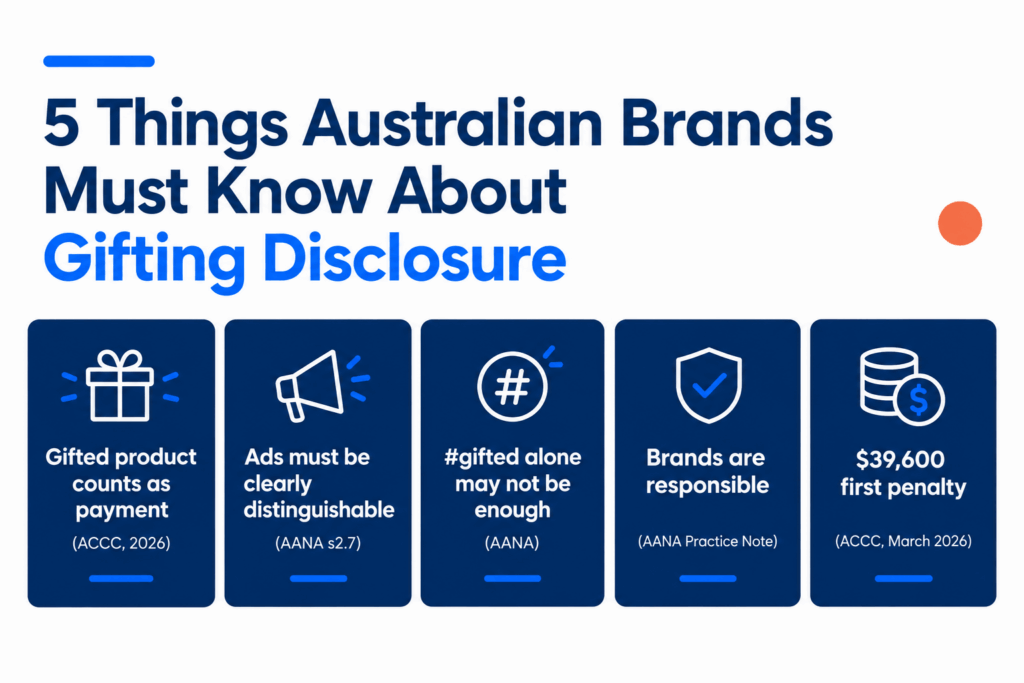
- Gifted product is payment. The ACCC says disclosure applies whether a creator is paid in free products or services, or money (ACCC, 24 March 2026).
- First penalty against a brand. PhotobookShop paid $39,600 after the ACCC issued two infringement notices over influencer reviews (ACCC, 24 March 2026).
- The core rule. Section 2.7 of the AANA Code of Ethics requires advertising to be clearly distinguishable as such (AANA Code of Ethics, valid from 1 February 2021).
- “Gifted” alone may not be enough. The AANA Practice Note lists gifted, collab and spon among less clear labels (AANA Practice Note, 2021).
- Brands are responsible. The AANA Practice Note places responsibility for compliant content on the brand owner (AANA Practice Note, 2021).
- Non-disclosure is common. 81% of 118 influencers in the ACCC’s sweep made posts that raised concerns (ACCC sweep report, December 2023).
- Audiences expect it. 84% of Australians say it is important influencers disclose advertising (Ad Standards and Roy Morgan, July 2026).
Does gifted product count as advertising in Australia?
Yes. Gifted product counts as payment under Australian rules. The ACCC treats free product given in exchange for content as a commercial relationship that must be disclosed, and the AANA Code of Ethics treats a post made in return for free product as advertising. If a creator posts because you sent them something, the post is an ad.
Gifted product is commercial consideration
Commercial consideration is anything of value exchanged for a promotion, and a free product qualifies. When the ACCC announced the PhotobookShop penalties in March 2026, Deputy Chair Catriona Lowe said the disclosure duty applies “whether that payment is free gifted products or services, or money”.
The AANA Code of Ethics Practice Note takes the same position in industry terms. Where a creator accepts money, free products or free services in exchange for promoting a brand, the relationship must be disclosed in a way the audience easily understands.
Commercial relationship (for disclosure purposes):
Any arrangement where a creator receives money, free product, a discount, a commission or another benefit from a brand and then promotes that brand. Under Australian rules, the commercial relationship behind a post must be disclosed in the post itself.
The commercial relationship test
The ACCC’s 2023 internet sweep of 118 influencers asked one question of every promotional post. Would an ordinary consumer understand from the post that the creator received payment, gifts or other incentives? If the answer is no, the post is at risk.
The same ACCC report lists signals that suggest a commercial arrangement but do not disclose one on their own:
- Tagging or thanking the brand in the post.
- Prominently featuring the product in a photo or video.
- Posting a discount code or referral link.
- Using platform disclosure tools on some posts but not others.
Why “I just gave them the product” does not exempt the brand
Many founders assume gifting is lower risk than paid posts because no money changed hands. PhotobookShop is the counter-example. The gifted photobooks were worth around $50 to $400 each, and the business still paid $39,600 in penalties.
The AANA Code of Ethics applies to marketing communications under a brand’s reasonable control, whether or not payment was involved. The Ad Standards Community Panel has even treated inviting a creator to a brand event as enough to make the resulting post advertising (Ad Standards determination, June 2025). If you are planning your first campaign, work disclosure into the plan from day one, using our guide on how to launch an influencer gifting campaign.
Unsolicited product seeding is the grey zone. If you send product with no request to post, the creator still has a relationship with you once they post about it. The safe course is to disclose, and the brief is where you say so. Our explainer on product seeding covers when seeding makes commercial sense.
Which disclosure labels does the AANA accept, and which does it not?
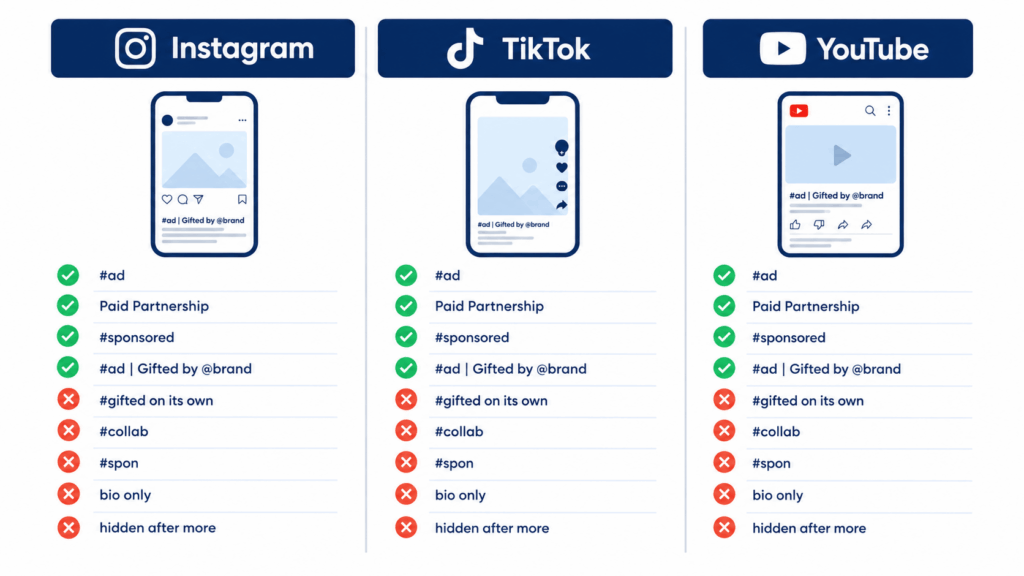
The AANA Practice Note names #ad, Advert, Advertising, Branded Content, Paid Partnership and Paid Promotion as clear labels. It flags #sp, Spon, gifted, Affiliate, Collab, “thanks to” and a bare brand mention as less clear labels that may not be enough. For gifting campaigns, the safest pattern is #ad combined with the word “gifted”.
| Label or method | Regulator or code position | Use in a gifting campaign? |
|---|---|---|
| #ad, Ad, Advertising | Named as clear by the AANA Practice Note | Yes. Safest default |
| Paid Partnership or Paid Promotion | Named as clear by the AANA Practice Note | Yes |
| #sponsored | Listed by Ad Standards as an acceptable hashtag | Yes |
| #gifted on its own | Listed by the AANA as less clear; may not be sufficient | Only after #ad |
| #collab, #spon, #sp | Less clear (AANA); flagged as vague by the ACCC in 2023 | No |
| Tagging or thanking the brand only | A brand mention may not be sufficient (AANA) | No |
| Disclosure only in bio | Flagged by the ACCC in its 2023 sweep | No |
| Disclosure after “more” or in a hashtag block | Flagged by the ACCC in its 2023 sweep | No |
Sources: AANA Code of Ethics Practice Note (2021); Ad Standards influencer disclosure guide; ACCC influencer sweep report (December 2023).
This is where most gifting guides get it wrong. #gifted feels accurate, and it is honest about what happened. But the AANA Code of Ethics Practice Note lists “gifted” among the labels that may not clearly mark a post as advertising. The practical fix is to lead with #ad and add the gifting detail after it: “#ad | Gifted by @yourbrand”.
Placement: where the disclosure has to go
Placement matters as much as the label. The ACCC’s 2023 sweep flagged these placement failures:
- Disclosures at the end of long captions, hidden behind “more”.
- Spoken disclosures only at the end of a long video.
- Disclosures mixed into a long list of other hashtags.
- Disclosures in a video description but not in the video itself.
- Small or low-contrast text, such as white #ad on a white background.
- Disclosures in the account bio only.
The rule of thumb is to put the label in the first line of the caption, before the “more” cut-off. For video, say it in the opening seconds and show it on screen. Ad Standards’ influencer guide encourages written disclosure on video because many viewers watch with the sound off.
Platform-specific requirements: Instagram, TikTok and YouTube
Australian rules apply the same way on every platform. Platform tools help, but they do not replace a clear written label in the caption or on screen.
| Platform | Built-in tool | What to add |
|---|---|---|
| Paid Partnership label | #ad in the first caption line. Stories count too, and Collab posts still need #ad (Ad Standards) | |
| TikTok | Content disclosure setting | #ad at the start of the caption, spoken and on screen early in the video |
| YouTube | Paid promotion checkbox | Spoken and on-screen disclosure at the start, plus “Ad” in the first line of the description |
Platform settings change. Check each platform’s current branded content settings before a campaign goes live.
Who is responsible when a creator does not disclose?
Both parties carry risk, but the brand carries more of it under the industry code. The AANA Practice Note places responsibility for compliant content on the brand owner, and Ad Standards does not make formal findings against influencers. Under the Australian Consumer Law, the ACCC can act against creators, brands and anyone who facilitates the arrangement.
Brand liability under the AANA Code and the Australian Consumer Law
The AANA Code of Ethics is administered by Ad Standards, and complaints are decided against the advertiser, meaning the brand owner. The ACCC’s December 2023 report confirmed that the Australian Consumer Law applies to brands and marketers who use influencers, not only to the influencers themselves.
The ACCC has also said it will consider the role of brands, advertisers, marketing firms and platforms in facilitating undisclosed posts. A creator’s missing #ad is your problem, not just theirs.
Creator liability
Creators who promote products in trade or commerce are covered by the Australian Consumer Law. The ACCC’s sweep report was aimed squarely at influencer conduct, and the PhotobookShop case began when a creator reported the brand’s contract to the ACCC. Creators who refuse to hide a commercial relationship are protecting themselves as well as their audience.
How Ad Standards handles an influencer complaint
- Anyone can lodge a complaint with Ad Standards about a post they believe is undisclosed advertising.
- Ad Standards checks whether the complaint falls under the AANA Codes.
- The advertiser is notified and asked to respond.
- The Ad Standards Community Panel decides whether section 2.7 has been breached.
- A case report is published, and the brand is expected to modify or remove a post found in breach.
The consequence goes beyond a published ruling. The ACCC said in 2023 that it monitors adverse Ad Standards findings to assess whether they raise Australian Consumer Law concerns.
The March 2026 PhotobookShop penalty
On 24 March 2026, Tomsem Consolidated Pty Ltd, trading as PhotobookShop, paid $39,600 after the ACCC issued it two infringement notices. The ACCC said that between August 2024 and September 2025, the business instructed creators on 107 occasions not to disclose they had received free product for their reviews.
The first notice related to an undisclosed, commissioned creator review that PhotobookShop posted to its own Instagram page. The second related to PhotobookShop editing a creator’s video to remove comments that the design tool was “a bit fiddly” and “a bit confusing”. The matter was resolved through infringement notices rather than the Federal Court, and paying an infringement notice is not an admission of a contravention.
Four lessons for any brand running gifting:
- Never ask creators to hide that product was free.
- Treat your creator contract as evidence, because regulators will read it.
- Remember that reposting creator content on your own channels makes it your advertising.
- Never edit a review to remove honest criticism.
Enforcement has continued since. In June 2026, Hismile paid $138,600 after seven ACCC infringement notices over social videos that presented employees as random shoppers (ACCC, 12 June 2026).
Build disclosure into every brief
Referwo keeps your creator brief, creator chat and content approvals in one place. Add your disclosure requirement and the #ad hashtag to the campaign brief, and every creator sees them before a single parcel ships. Run compliant gifting campaigns on Referwo.
Disclosure checklist for your creator brief
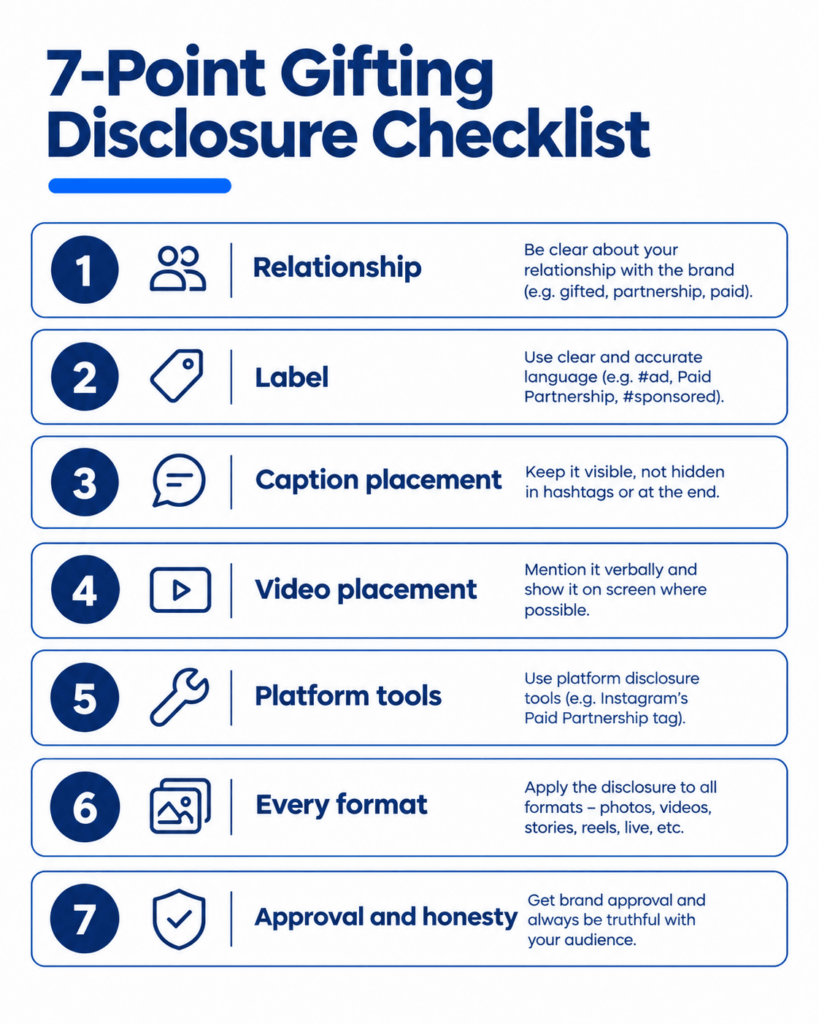
Add these seven points to every creator brief before product ships. Together they confirm the commercial relationship, specify an accepted label, fix its placement, cover every format the creator might post, and give you a chance to check the post before it goes live. Copy them as written, then replace the bracketed details.
- Relationship: “This content is part of a commercial arrangement. You are receiving [product] from [Brand] free of charge in exchange for content.”
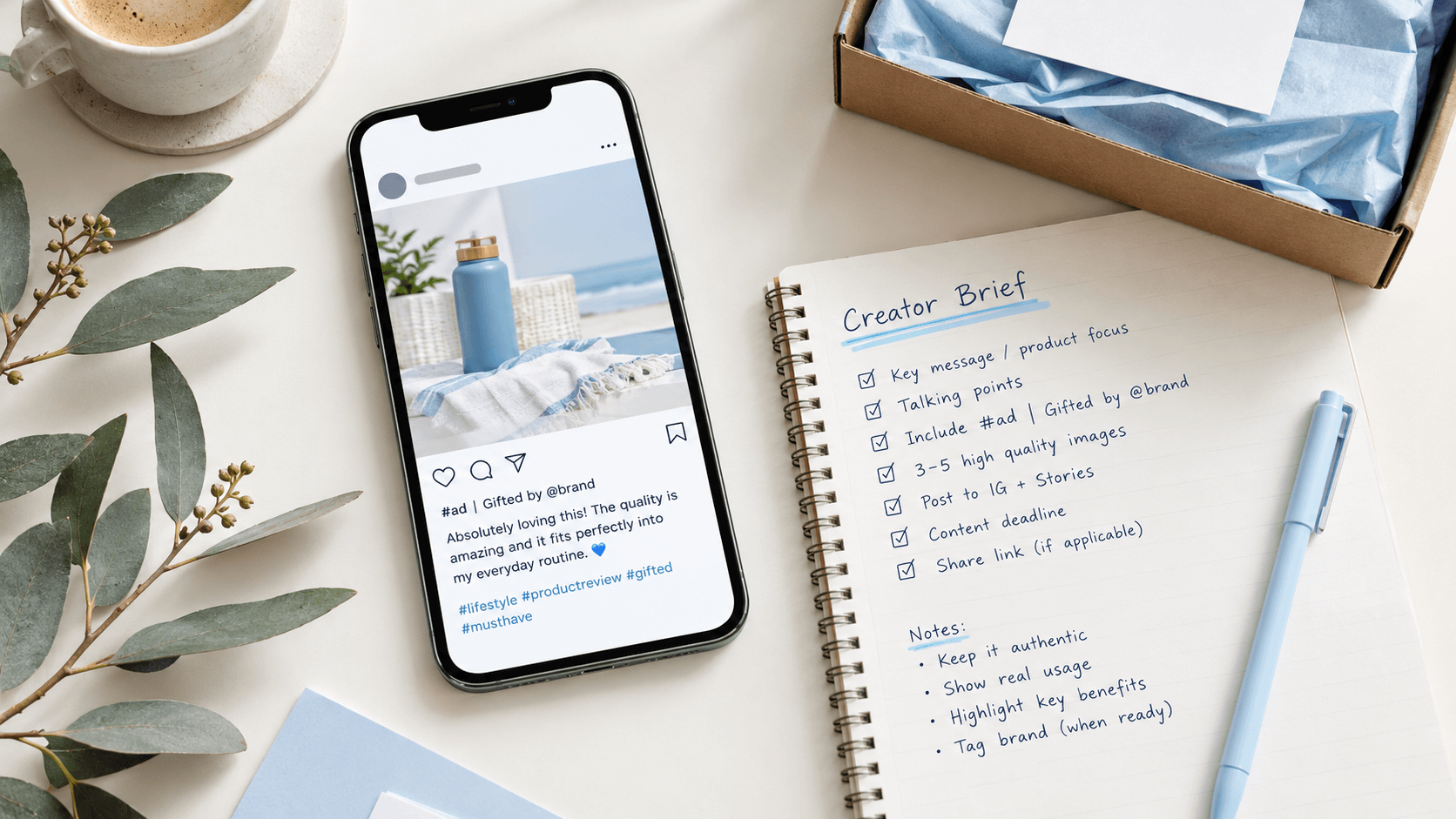
- Label: “Use #ad, Ad or Advertising on every post. You may add ‘Gifted by @[brand]’ after the #ad label. Do not use #gifted, #collab, #spon or #sp on their own.”
- Caption placement: “Place the label in the first line of the caption, before the ‘more’ cut-off. Do not bury it in a hashtag block or put it only in your bio.”
- Video placement: “Say ‘This is an ad, [Brand] sent me this product’ at the start of any video, and show the label on screen.”
- Platform tools: “Switch on the platform’s branded content setting as well as the written label: Paid Partnership on Instagram, content disclosure on TikTok and the paid promotion checkbox on YouTube.”
- Every format: “Disclose on every post, Story, Reel, video and repost about [Brand], including later posts after the campaign ends.”
- Approval and honesty: “Submit your draft for approval before posting. [Brand] reviews drafts for disclosure and factual accuracy only, and will not ask you to remove honest opinions.”
Disclosure language for each platform
| Platform | First line of caption | Spoken line |
|---|---|---|
| Instagram feed and Reels | #ad | Gifted by @[brand] | “Ad. [Brand] sent me this to try.” |
| Instagram Stories | “Ad | Gifted by @[brand]” text on every frame showing the product | Not required if the text label is clear |
| TikTok | #ad Gifted by @[brand] | “This is an ad. [Brand] sent me this for free.” |
| YouTube | Ad: [Brand] sent me this product for free. | “[Brand] sent me this product for free, so this video is an ad.” |
Put the same obligations into the written agreement, not only the brief. Our guide to what should be in your influencer agreement contract covers the clauses that sit alongside disclosure, and our overview of gifted influencer campaigns in Australia covers product value, creator selection and expected outcomes.
How to build disclosure into your Referwo campaign brief
Referwo does not add disclosure to a campaign brief by default. The brand adds it: a requirement for creators to include a disclosure statement, plus the hashtags they must use, such as #ad. Creator chat and content approvals sit in the same workflow, so the brand can confirm the label is there before anything goes live.
Add disclosure and hashtags to your campaign brief
Disclosure is not a default setting, so it has to be written in. On Referwo, creators apply to your campaign after reading your brief, which makes the brief the right place to set the rule.
Add a requirement that creators include a disclosure statement in their content. Then add the hashtags you want in every post, such as #ad. Pasting the seven-point checklist into the brief covers both, so every applicant sees your disclosure terms before you approve them or ship product.
Content approvals catch missing labels before posting
Use content approvals as your compliance gate. Check that the label sits in the first line and in the opening seconds of video, then approve. If a creator repeatedly ignores the brief, Referwo’s flagging system lets you report it.
Keep the approval step honest. Approving for disclosure and accuracy is good practice, while editing out criticism is exactly what drew the second PhotobookShop notice.
Tracked codes create a record of every relationship
Referwo gives each creator a unique discount code and trackable link, and approved gifting creators self-checkout with single-use codes through Shopify or WooCommerce. That gives you a clear record of who received product and what they promoted.
Remember that a discount code in a caption is itself a sign of a commercial arrangement, so code posts need #ad too. For more on running gifting well, see our influencer gifting platform use cases and strategies and how brands should use influencer gifting in 2026. If you want help setting up your first compliant brief, speak to our campaign team.
Frequently asked questions
Does gifted product count as advertising in Australia?
Yes. The ACCC treats free product given in exchange for content as payment, and the AANA Code of Ethics treats the resulting post as advertising. If a creator posts about a product because you sent it, the post must be clearly labelled as an ad, usually with #ad or “Paid partnership” at the start of the caption.
What hashtags does the AANA accept for disclosure in Australia?
The AANA Practice Note names #ad, Advert, Advertising, Branded Content, Paid Partnership and Paid Promotion as clear labels. Ad Standards also lists #sponsored and #PaidPromotion. Labels such as #sp, Spon, gifted, Affiliate and Collab may not be sufficient on their own.
Can you just put #gifted at the end of an Instagram caption?
No. The AANA Practice Note lists “gifted” among the less clear labels that may not be sufficient, and the ACCC has flagged disclosures placed at the end of long captions. Put #ad in the first line of the caption, then add “Gifted by @brand” after it if you want to explain the arrangement.
Is a brand responsible if a creator does not disclose?
Yes. The AANA Practice Note places responsibility for compliant content on the brand owner, and Ad Standards decides complaints against the advertiser. The Australian Consumer Law also applies to brands that use influencers. Including disclosure requirements in your creator brief and checking posts before they go live is the practical way to manage that risk.
What happens if a creator does not disclose a gifted product in Australia?
Anyone can complain to Ad Standards, which can find the brand in breach of the AANA Code and expect the post to be modified or removed. The ACCC can also take action under the Australian Consumer Law. In March 2026, PhotobookShop paid $39,600 after two ACCC infringement notices over undisclosed gifted reviews.
Do YouTube creators need to disclose gifted products in Australia?
Yes. The same Australian rules apply on YouTube. The ACCC has flagged disclosures that appear only in a video description or only at the end of a long video. Creators should say it is an ad at the start, show it on screen, tick the paid promotion setting and put “Ad” in the first line of the description.
What is the AANA Influencer Marketing Code of Practice?
There is no AANA code by that name. The AANA rule that governs influencer posts is section 2.7 of its Code of Ethics, valid from 1 February 2021, with guidance in its Practice Note. The Influencer Marketing Code of Practice is published by the Australian Influencer Marketing Council (AiMCO) as industry best practice.
Is “collaboration” (#collab) an acceptable disclosure hashtag in Australia?
No. The AANA Practice Note lists Collab as a less clear label, and the ACCC’s 2023 sweep named “collab” as vague and confusing. Ad Standards also notes that Instagram Collab posts still need a hashtag such as #ad to show they are advertising.
Do I need disclosure if I gave the product for free and did not ask for a post?
Usually, yes, if the creator posts about it. The Ad Standards Community Panel has found that providing free product can establish a relationship as if payment had been made, and Ad Standards advises creators to disclose when unsure. If you reshare the post on your own channels, it becomes your advertising and must be clearly labelled.
What is Ad Standards Australia and how does it handle influencer complaints?
Ad Standards administers the AANA advertising codes and runs the public complaints process. For influencer posts, its Community Panel decides whether a post breaches section 2.7 of the AANA Code of Ethics. Findings are made against the advertiser, case reports are published, and a post found in breach is expected to be modified or removed.
How do I include disclosure requirements in my influencer brief?
Add a disclosure section that confirms the commercial relationship, names the label to use (#ad), sets its placement (first caption line and start of video), covers every format including Stories, requires platform branded content tools, and asks for drafts before posting. The seven-point checklist in this article can be pasted in directly.
Does Referwo include disclosure language in its campaign brief templates?
Not by default. Brands add disclosure to their Referwo campaign brief themselves, as a requirement for creators to include a disclosure statement, and can add the hashtags creators must use, such as #ad. The seven-point checklist above can be pasted straight into the brief, and content approvals let brands check each post for the label before it goes live.
The bottom line
Gifting feels informal, which is exactly why it is where most disclosure failures happen. If you sent it, the post is an ad, and your brief should say so before the parcel leaves. Get the brief right and disclosure becomes a routine check rather than a regulatory risk. If you want every gifting campaign to launch with disclosure written into the brief and checked at approval, run compliant gifting campaigns on Referwo.
Disclaimer:
This article contains general information only and does not constitute legal advice. Refer to accc.gov.au and aana.com.au for official guidance. Information current as of September 2026. Regulatory guidance may change, so check accc.gov.au for updates.
Sources
- ACCC, PhotobookShop pays penalties for influencer reviews (24 March 2026)
- ACCC, Hismile pays penalties for false and misleading social media videos (12 June 2026)
- ACCC, Social media influencer testimonials and endorsements: findings of the internet sweep (December 2023)
- ACCC, Social media promotions guidance for business (updated July 2026)
- AANA, Code of Ethics and Practice Note (valid from 1 February 2021)
- Ad Standards, Influencer marketing: a guide to disclosing ad content
- AiMCO, Best practice and ad disclosure resources
- Ad Standards and Roy Morgan, Community Sentiment Tracker: disclosure and transparency (July 2026, survey of 1,006 Australians)
About the author: Ewen Ling is the co-founder of Referwo and an ecommerce entrepreneur with 16 years of hands-on experience. He co-founded Elinz Electronics in 2005 and scaled it into a fully operational business before managing a successful exit for shareholders in 2021. At Referwo, Ewen helps ecommerce brands build influencer marketing programmes that generate measurable revenue, not just reach.