

By Ewen Ling, Co-Founder, Referwo | Ecommerce Growth Strategist
Last updated: September 2026
A gifted influencer campaign in Australia usually costs only the product and shipping, which makes it far cheaper than a paid partnership. Gifting works, but not in the way brands often hope. It reliably produces authentic content and brand awareness, and it builds creator relationships, while direct sales are less predictable than they are with a paid or commission campaign.
On Referwo, creators who accept a gifted campaign are required to post content – so you are not waiting on a favour. The trade-off compared to a paid collaboration is quality control, not posting obligation. With paid campaigns, brands can hold payment until they have reviewed and approved the content. With gifted, you have less leverage over revisions, so the fit between product and creator matters more from the start.
One rule is not optional. Under Australian Consumer Law and the AANA Code of Ethics, a gifted post that is part of a commercial arrangement must be clearly disclosed as advertising. This guide covers what to budget, how to stay compliant, what results to expect, and how to structure a gifting campaign creators actually respond to.
Quick Answer
Gifted influencer campaigns in Australia usually cost only the product and shipping – far cheaper than paid partnerships. On Referwo, creators who accept a gifted product are required to post, though brands have less control over content quality compared to paid campaigns, where payment can be held until revisions are approved. Under ACCC guidance and the AANA Code of Ethics, all gifted posts must be clearly disclosed as advertising. Results lean toward authentic user-generated content (UGC) and brand awareness rather than guaranteed direct sales, and response rates improve significantly when the gifted product genuinely suits the creator’s audience.
The short answer: does gifting work for influencer marketing?
Gifting works best as a content and awareness strategy, not a direct-sales one. If your goal is a library of authentic user-generated content (UGC) and steady brand exposure, gifting delivers at a very low cost. If your goal is immediate, trackable sales, a commission-based approach usually performs better – though the two combine well.
Definition – Gifted influencer campaign:
A collaboration where a brand sends a creator free product in exchange for content, rather than paying a cash fee. The brand’s cost is the product and shipping, not a rate.
The key distinction between gifted and paid is not whether content gets posted – on Referwo, gifted creators are obligated to post when they accept a campaign. The real difference is what control the brand retains over the final output. In a paid collaboration, the brand can request revisions and hold payment until the content meets the brief. In a gifted arrangement, the brand has less leverage over quality, which means creator selection becomes your primary quality control mechanism.
In my experience, the brands that get the most from gifting treat it as the first step in a relationship, not a one-off transaction. A creator who genuinely likes a gifted product often becomes a paid or commission partner later. For a fuller comparison of the models, see our guide to gifted vs paid campaigns.

Typical product costs to budget by creator tier
Budget your gifting cost as the cost of goods plus shipping, scaled to the creator tier you are targeting. The right product value rises as the creator’s audience grows, because larger creators receive more offers and expect more. Match the product to the tier, not to a fixed dollar figure.
| Creator tier | Follower range | Recommended gift | Gifting model |
|---|---|---|---|
| Nano | Under 10,000 | Single hero product | Product only – most likely to post for gift alone |
| Micro | 10,000–100,000 | Small bundle or higher-value item | Product only – receives more offers, so value matters |
| Mid-tier | 100,000–500,000 | Premium bundle | Often requires a cash fee on top of the gift |
Pure gifting is most cost-effective at the nano and micro tiers. By mid-tier, gifting typically becomes gifting plus payment, which shifts it toward a paid campaign. For most small Australian brands, nano and micro creators are where a gifting budget stretches furthest.
Value matters more than volume. One relevant, well-chosen product sent to a creator whose audience matches your customers will beat a cheap item scattered across dozens of mismatched creators. To set the wider budget, see our breakdown of influencer marketing costs, and to shortlist the right creators, our guide on how to find micro-influencers.
Disclosure and compliance rules for gifted campaigns (ACCC and AANA)

A gifted post must be clearly disclosed as advertising whenever it is part of a commercial arrangement – and the brand shares responsibility for that disclosure, not just the creator. Two frameworks apply in Australia: the Australian Consumer Law, enforced by the Australian Competition and Consumer Commission (ACCC), and the AANA Code of Ethics. Getting this wrong is now a financial risk, not just a reputational one.
The core rule sits in section 2.7 of the AANA Code of Ethics: advertising must be clearly distinguishable as such. The Code applies whether or not money changed hands, so free product counts, and it covers user-generated content (UGC) the brand has reasonable control over. The Code is administered by Ad Standards, which handles public complaints.
The label matters. The AANA accepts clear tags such as #ad, Advertising, Branded Content, and Paid Partnership. Vaguer labels are not sufficient – including #sp, Spon, Collab, and, notably, the word gifted on its own, because audiences do not reliably read it as advertising. Burying a disclosure at the end of a long caption is also not acceptable.
This is now enforced with financial penalties. In March 2026, the ACCC issued penalties of $39,600 against online retailer PhotobookShop – the regulator’s first financial penalty for influencer disclosure failures. The ACCC found that, on 107 occasions, the brand had instructed creators not to disclose they had been given free product, and it also penalised the brand for editing an honest review to remove a negative comment.
Never ask a creator to hide that a product was gifted, and never edit out their genuine opinions. The ACCC has made clear that a payment includes free product, and that Australian consumer law applies online exactly as it does in a physical shop. This is general information, not legal advice – confirm your obligations with a qualified professional for your specific campaign.
What results should brands realistically expect?
Expect content and awareness as the reliable outcomes of gifting, with direct sales as upside rather than a guarantee. A realistic gifting campaign delivers a batch of authentic UGC, some organic reach, and a set of new creator relationships. Judge the channel on content output, not on sales alone.
Three outcomes are worth planning for separately:
- User-generated content (UGC): The most dependable return. Gifted content can be reused on product pages, ads, and social – and it is cheaper and more authentic than a studio shoot.
- Brand awareness: Gifting puts your product in front of engaged niche audiences, building recognition over time through genuine recommendations.
- Direct sales: Possible but less predictable, and best captured by adding a trackable discount code or affiliate link alongside the gift.

To add a sales layer, pair gifting with an affiliate incentive. The gifting built the content and the trust; the commission turned that trust into tracked sales.
For a deeper look at measuring what your campaigns actually produce, see our guide to harnessing the power of UGC.
How to structure a gifted campaign creators respond to
Structure a gifting campaign around relevance and respect, because those two things drive the quality and authenticity of what creators post. The brands that get the best content send a genuinely useful product to a well-matched creator, with a clear brief and realistic expectations about what you can direct.
- Match the product to the creator’s audience – so the gift feels relevant rather than random, and the content resonates with their followers.
- Personalise the outreach – name the specific content that made you choose them. Generic mass-send messages get ignored.
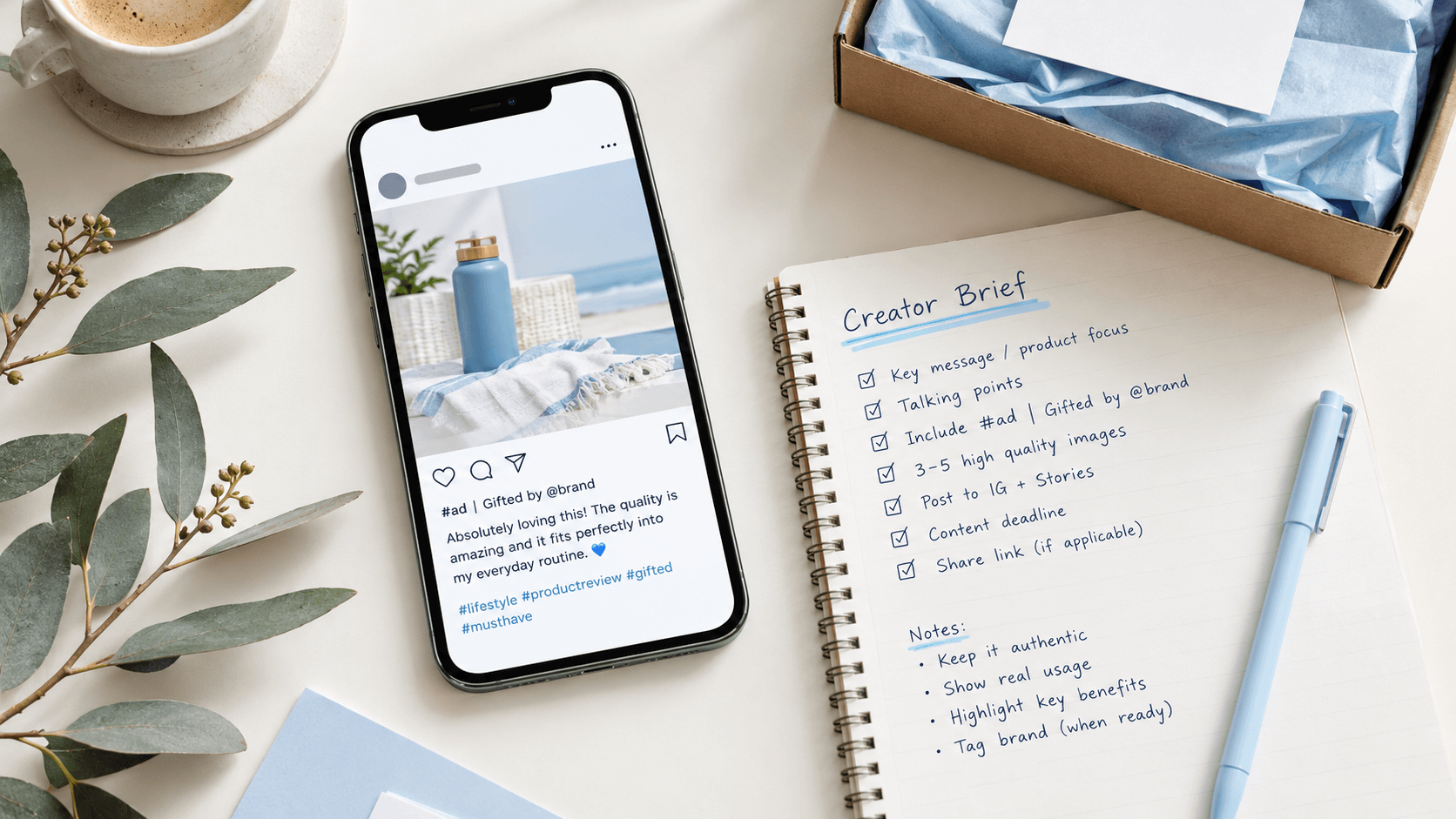
- Brief clearly but lightly – explain the key message you want conveyed, the disclosure label to use, and any brand guidelines, but leave room for the creator’s voice.
- Make disclosure easy – tell the creator exactly which label to use (#ad or Paid Partnership), so compliance is frictionless for both sides.
- Offer a next step – an affiliate code gives a motivated creator a way to earn from sales they drive, and converts a gifted relationship into a performance one.
The biggest mistake is expecting paid-campaign levels of content control from a gifted arrangement. On Referwo, creators are obligated to post – but you cannot hold payment to require revisions the way you can in a paid deal. Set a clear brief upfront, choose creators whose existing content already reflects your brand standards, and treat the content you receive as authentic rather than produced.
A platform makes the volume manageable. Referwo lets Australian brands run gifted campaigns where creators apply to them, tracks any affiliate codes automatically, and keeps outreach, approvals, and content in one place – so a small team can run gifting at scale without a spreadsheet.

Frequently asked questions
Do I have to pay influencers or can I just gift products?
You can gift products instead of paying cash, and many nano and micro creators will work on gifted campaigns. On Referwo, creators who accept a gifted campaign are obligated to post – you are not relying on goodwill alone. The key trade-off versus a paid collaboration is content quality control: with paid campaigns, you can hold payment until you have reviewed and approved the content and requested revisions. With gifted, your leverage over quality comes from your brief and your creator selection rather than from a payment review process.
Do influencers have to disclose gifted products in Australia?
Yes. When a gift is part of a commercial arrangement, the post must be clearly disclosed as advertising under the AANA Code of Ethics and Australian Consumer Law. A clear label like #ad or Paid Partnership is required. The word gifted on its own may not be sufficient — the AANA’s position is that labels must be easily understood as advertising by the audience. The brand is also responsible for disclosure, not only the creator, and the ACCC has issued financial penalties for hiding gifting.
How much product should I send an influencer?
Send something genuinely valuable and relevant to the creator’s audience, scaled to their tier. A nano creator typically responds well to a single hero product; a micro creator to a small bundle; and a mid-tier creator usually expects a premium bundle and often a cash fee alongside it. Relevance beats quantity — a well-matched single item will consistently outperform a cheap generic parcel.
Do gifted influencer campaigns actually work for small brands?
Yes, particularly for building authentic content and brand awareness on a small budget. On Referwo, creators are obligated to post when they accept a gifted campaign, which removes the uncertainty that exists with informal gifting arrangements.
The bottom line
Gifting is one of the most cost-effective tools available to a small Australian brand — not because it guarantees sales, but because it generates authentic content and builds creator relationships at a fraction of the cost of paid campaigns. Understand what you are buying: on Referwo, creators are required to post, but quality control works differently to paid. Set a clear brief, choose creators whose audience genuinely matches your customers, disclose every collaboration properly, and add an affiliate layer when you want a sales signal. Do that, and a gifting programme pays for itself in content alone.
If you want to run gifted, affiliate, and paid campaigns in one place with creator obligations built in, see how Referwo works for brands.
About the author: Ewen Ling is the co-founder of Referwo and an ecommerce entrepreneur with 16 years of hands-on experience. He co-founded Elinz Electronics in 2005 and scaled it into a fully operational business before managing a successful exit for shareholders in 2021. At Referwo, Ewen helps ecommerce brands build influencer marketing programmes that generate measurable revenue, not just reach.