


Influencer Marketing KPIs: What Actually Matters in 2026
The core influencer marketing KPIs in 2026 are Return on Ad Spend (ROAS), Return on Investment (ROI), and Customer Acquisition Cost (CAC) to measure direct revenue. For vetting creators, prioritize engagement-to-like ratios and comment specificity. E-commerce founders must separate trackable sales data from top-of-funnel visibility metrics like reach.
Most e-commerce founders treat creator partnerships as a discretionary branding expense rather than a highly measurable sales channel. After 15 years in retail and e-commerce, I have witnessed this operational bottleneck repeatedly. Brands struggle to calculate actual returns because they rely on scattered spreadsheets, manual outreach, and subjective matching. Managing campaigns without clear, real-time performance data prevents predictable growth and creates severe operational friction.
Scaling a profitable programme in 2026 requires entirely abandoning these manual processes. You must shift your operational focus toward performance-driven metrics. Systemising your approach allows you to measure the exact dollar value every influencer brings to your business. Data beats guesswork. Understanding which Key Performance Indicators (KPIs) actually matter—and which are simply indicators of visibility—is the first step toward building a creator-led revenue engine.
Visibility Metrics vs. Revenue Metrics

The industry frequently misunderstands the purpose of different data points, leading to misallocated budgets and failed campaigns. Reach, impressions, and engagement rates are legitimate metrics for visibility. They serve a highly important purpose at the very top of your sales funnel. They indicate brand awareness and demonstrate how well a creator’s content resonates with their specific audience before a purchase decision is made.
However, visibility does not automatically translate into trackable revenue. Founders run into deep operational trouble when they use visibility metrics to measure conversion success. A post that goes viral, generating millions of impressions but zero trackable sales, is a failed campaign in a performance-led commercial model.
Scaling requires you to separate your visibility data from your revenue data. You must treat creators as a highly measurable system for generating sales. Testing small with commission-based models allows you to validate creator-audience fit using visibility data first. Once you establish that a creator drives actual conversions, you can confidently scale their specific budget based on strict revenue KPIs.
The Core Revenue KPIs for 2026
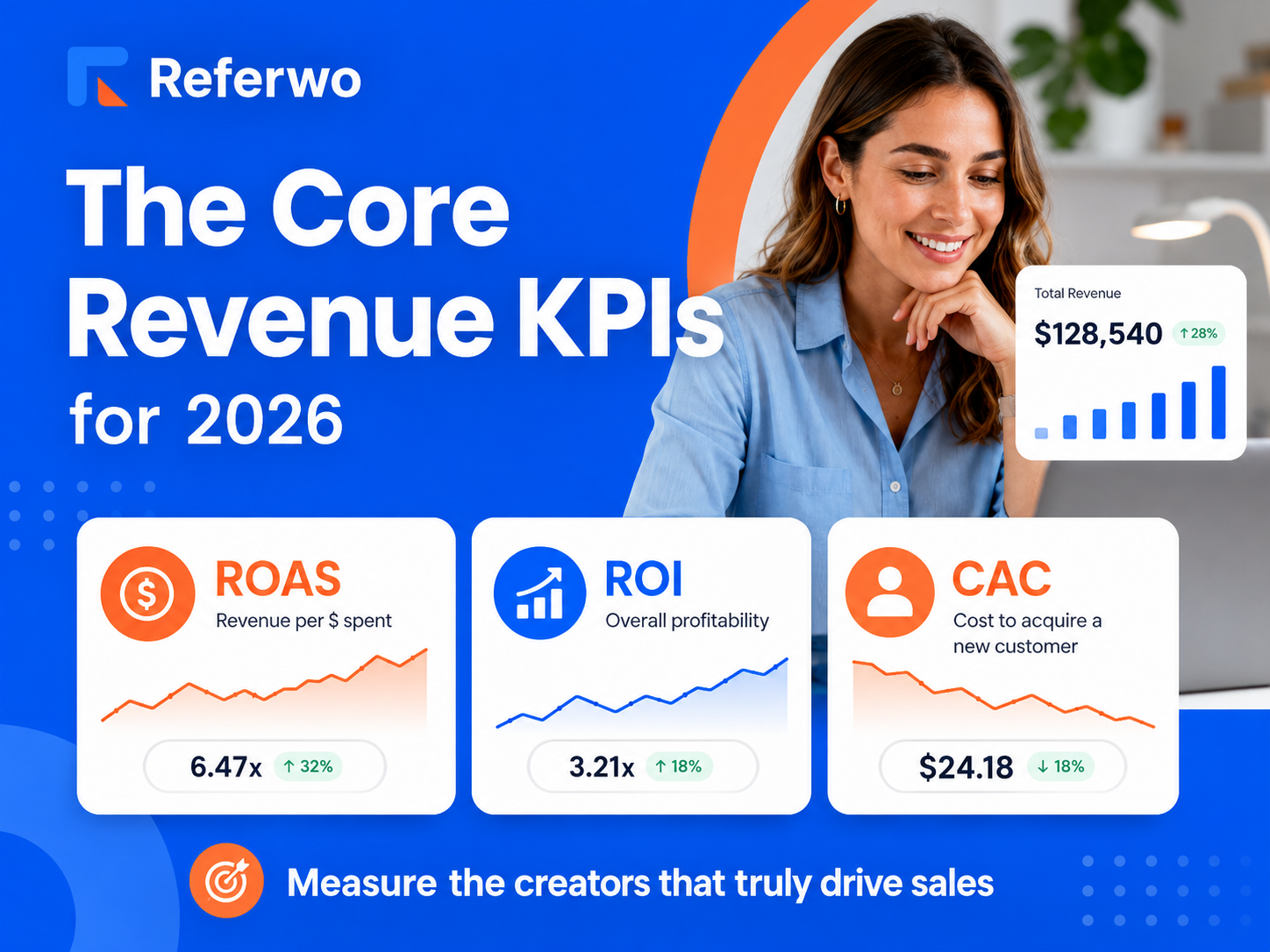
Performance-driven influencer marketing is grounded entirely in commercial evidence. Hard data validates the creator-led sales model. To measure true performance, e-commerce brands must track the following primary revenue KPIs relentlessly.
Return on Investment (ROI)
While ROAS measures top-line revenue against direct ad spend, ROI measures the overall profitability of the campaign. ROI accounts for the cost of goods sold (COGS), shipping, platform fees, and the cost of the gifted product itself. According to global industry benchmarks, the average ROI for influencer marketing is $5.78 for every $1 spent.
Our active platform partners consistently exceed these baseline benchmarks by moving away from untrackable outreach and moving toward systemised, data-led partnerships.
Return on Ad Spend (ROAS)
ROAS measures the gross revenue generated for every dollar spent on a specific creator campaign. It is the most direct indicator of immediate campaign profitability. You calculate this by dividing the total campaign revenue by the total direct campaign cost. If you pay a creator $1,000 and they generate $5,000 in trackable sales through their unique storefront, your ROAS is 5x. High-performing brands systemise their tracking to isolate which specific creators are driving the highest multiples.
Customer Acquisition Cost (CAC)
CAC determines exactly how much it costs your business to acquire a single new paying customer through a creator’s content. You calculate this by dividing your total campaign spend by the number of new customers acquired.
This metric is critical for cross-channel budgeting. Comparing your influencer CAC against your broader paid social CAC—such as campaigns run through Meta Ads or Google Ads—dictates your ultimate budget allocation. If an influencer generates a lower CAC than your standard Facebook ads, you should immediately divert more of your marketing budget to that specific creator to maximize profitability.
Data-Anchored Results: The Proof of Scale
We see the power of focusing strictly on revenue KPIs when reviewing successful Referwo case studies from our active partners. By enforcing strict tracking protocols, these brands achieved exceptional metrics:
- Thread the Word: Systemised their approach to creator partnerships, generating $59,547 in sales. This resulted in a 746% ROI and an 8.5x ROAS across their creator portfolio.
- Cherub Baby: Drove $34,855 in trackable sales, resulting in a 1,062% ROI and an 11.6x ROAS.
- Hannah & Henry: Delivered a 265% ROI and a 5.2x ROAS from $44,000 in total sales.
- Sole Sox: Achieved a 350% ROI and a 6.5x ROAS through highly targeted nano-influencer activations.
These figures demonstrate the clear superiority of real-time sales performance data over subjective matching. A campaign cannot scale effectively if a founder is forced to guess which creator drove which sale.
The Vetting KPIs: Spotting Red Flags Before You Spend
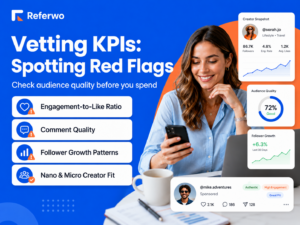
Scaling effectively requires vetting creators rigorously to ensure they have authentic audiences. Before committing any budget, founders must analyse specific vetting KPIs. Utilizing a rigorous checklist helps identify common red flags like engagement pods or bot-driven growth.
Engagement-to-Like Ratio
Audience size means nothing if the audience is not interacting. However, high likes can easily be purchased. The engagement-to-like ratio is a critical diagnostic tool. A creator with 100,000 likes but only 12 comments represents a massive risk for fake engagement. Authentic audiences leave comments, save posts, and share content.
Nano and Micro-Influencer Benchmarks
Achieving high returns in 2026 relies heavily on activating the right tier of creators. Nano-influencers (1,000 to 10,000 followers) consistently drive superior conversion rates because they maintain highly active, niche communities. While macro-influencers often struggle to maintain engagement, micro-influencers typically maintain a strong 2.71% engagement rate, providing a much stronger foundation for performance-based campaigns than expensive celebrity endorsements.
Comment Quality and Specificity
You must evaluate the actual substance of the engagement. Authentic comments are highly specific to the content or the product being shown. You should heavily discount generic comments such as “Love this!” or “Beautiful profile!” spread across multiple posts. These are clear indicators of automated bot activity or orchestrated engagement pods.
Follower Growth Patterns
Organic growth takes time and follows predictable, steady curves. You must analyse a creator’s historical follower count. Sharp, vertical rises in follower counts followed by immediate, slow drops often indicate purchased followers. Partnering with these accounts will drain your budget and ruin your conversion metrics.
Aligning KPIs with Your Campaign Structure
Your choice of campaign structure fundamentally changes which KPIs you should prioritize. E-commerce founders must understand the operational differences when structuring affiliate vs gifted vs paid influencer campaigns to protect their profit margins.
To clarify how metrics shift based on the commercial arrangement, review the comparative data table below:
Campaign KPI Alignment Table
| Campaign Structure | Primary Goal | Core KPI Focus | Financial Risk to Brand | Best Use Case in 2026 |
| Gifted (Product Seeding) | Content generation & visibility | Cost Per Asset (CPA), Reach | Low (Cost of goods only) | Validating creator-audience fit; gathering UGC for paid ads. |
| Affiliate / Commission | Direct revenue generation | Direct Sales Volume, ROI | Zero (Pay-on-performance) | Scaling proven nano/micro creators; building “Solution Partners.” |
| Paid (Flat Fee) | Brand authority & mass reach | ROAS, Customer Acquisition Cost (CAC) | High (Upfront capital required) | Major product launches; working with established macro-creators. |
In a gifted campaign, since you are not paying a cash fee, the direct ROAS is less critical in the immediate term. The goal is to build an initial relationship and acquire user-generated content. Conversely, when you pay a flat fee for a dedicated post, you carry all the commercial risk and must hold the creator to strict ROAS metrics. Affiliate models remain the safest route, as they represent pure performance—you pay a percentage only when they drive a confirmed sale.
Financial Benchmarks and Seasonality in AU/NZ
Budget allocation must be strategic and data-driven. In the AU/NZ market, budgeting is tiered heavily by business stage and category competitiveness. Fast-growing e-commerce startups and mid-market brands often allocate 10-25% of their marketing budget to influencers, focusing primarily on activating vast networks of nano and micro-influencers rather than blowing capital on a single macro-post.
Founders must also account for commercial seasonality. During peak shopping periods like Black Friday, Cyber Monday, or the lead-up to Valentine’s Day, creator costs and paid social CPMs can spike by 20% to 30%. Planning your activations and locking in creator rates 4 to 6 weeks before these “tentpole” retail events allows for significantly better cost efficiency and protects your target CAC.
The “Dealshub” Strategy for Centralised Tracking
You cannot scale a measurable sales channel using fragmented systems. Tracking unique discount codes manually across hundreds of creators leads to severe data degradation. Transitioning away from this chaos requires implementing the correct technical infrastructure.
To maximize conversions, leading brands are moving toward long-term “Solution Partner” relationships. A key tool facilitating this shift is the “Dealshub” concept. This strategy utilizes a centralized system for consolidated discount codes and personalized influencer storefronts.
By featuring discount codes in a dedicated storefront, influencers provide ongoing exposure for brands even when they aren’t actively posting on their feeds. This ecosystem simplifies the purchase path for the consumer. It also ensures that every single sale is attributed to the correct creator without manual intervention. Connecting your e-commerce store directly to your creator management platform eliminates data silos completely. Brands ready to remove operational friction can review our software pricing tiers to find the exact technical alignment required for their current growth stage.
Regulatory Compliance as a Commercial KPI
Scaling a creator programme in Australia requires strict adherence to evolving legal frameworks. Compliance is no longer just a legal issue; it is a critical commercial metric. Brands hold the financial risk if their creator partners fail to comply with national standards.
The Australian Competition and Consumer Commission (ACCC) has set clear enforcement priorities for the 2025/26 cycle. Their primary focus is the absolute elimination of misleading or deceptive advertising across social platforms. This regulatory push specifically targets hidden endorsements and “fake” reviews.
Under strict national standards, any “material connection” must be explicitly disclosed. This connection includes cash payments, gifted products, or affiliate commissions. The disclosure must be clear, conspicuous, and proximate to the endorsement itself. Hiding a disclosure tag at the bottom of a lengthy caption violates these rules.
Furthermore, the Australian Influencer Marketing Council (AiMCO) provides the industry-agreed framework for transparency. AiMCO recently issued a new compliance rulebook helping creators navigate the specific legal requirements for social media giveaways. Australian brands must now manage strict permit rules and winner publication obligations. Failing to meet these standards presents a massive commercial liability. You must ensure your creators drive sales within the strict boundaries of Australian Consumer Law.
Systemising Your Post-Campaign Analysis
Generating data is useless if you do not have a system for analysing it. You must establish a rigorous, routine review process to determine which partnerships to scale and which to cut. Understanding exactly how to analyse influencer performance systematically is what separates stagnant brands from category leaders.
You should review performance data weekly during active campaigns. Look beyond the initial 48-hour spike. Measure the “long tail” of sales that come through personalized storefronts over a 30-day period. Identify the specific content formats (e.g., educational reels versus unboxing stories) that generated the lowest CAC.
Once you identify a high-performing partner, secure them on a longer-term hybrid contract. Offer a small base fee combined with a highly lucrative commission tier. This aligns their financial incentives perfectly with your revenue goals.
Conclusion: Engineering a Revenue Engine
Scaling influencer ROI in 2026 is a technical challenge, not a creative one. Moving to a performance-based model protects your margins. It transforms your influencer marketing from an unmeasured expense into a predictable revenue engine. Founders who adopt this measurable sales channel philosophy—focusing strictly on ROAS, ROI, and CAC—will dominate their respective categories. Reviewing our comprehensive solutions for brands provides a clear roadmap for implementing this necessary technical infrastructure and automating your performance analysis today.
Frequently Asked Questions
What is a good ROAS for influencer marketing in 2026?
A strong Return on Ad Spend (ROAS) for performance-driven influencer campaigns typically ranges between 3x and 6x. However, brands utilizing highly targeted nano-influencers and automated tracking platforms frequently see returns exceeding 8x to 10x, depending on their profit margins, average order value (AOV), and specific product category.
Why should I track engagement-to-like ratios?
Tracking the engagement-to-like ratio protects your marketing budget from fake audiences. High likes with minimal comments indicate purchased engagement or bot activity. Authentic creators generate specific, contextual comments from their followers, which is a required precursor to driving actual e-commerce sales.
Are reach and impressions considered vanity metrics?
No, reach and impressions are not vanity metrics when used correctly. They are legitimate metrics for visibility that indicate brand awareness and top-of-funnel resonance. However, they should never be used as the primary measure of commercial success or conversion performance, which must be judged by trackable revenue.
How does ACCC compliance affect influencer campaigns?
ACCC compliance is a mandatory commercial requirement for Australian brands. Failure to clearly disclose a material connection (like gifted products or cash payments) exposes the brand to significant legal liability, potential fines, and consumer trust degradation. Disclosures must be conspicuous and proximate to the content itself.
When should I use an affiliate model instead of a flat fee?
Affiliate models should be used when validating new creators or scaling a vast network of nano and micro-influencers where you want to eliminate financial risk. Flat fees are generally reserved for established macro-creators during major product launches where mass, immediate brand visibility is required alongside sales.