


By Ewen Ling, Co-Founder, Referwo | Ecommerce Growth Strategist
Last updated: October 2026
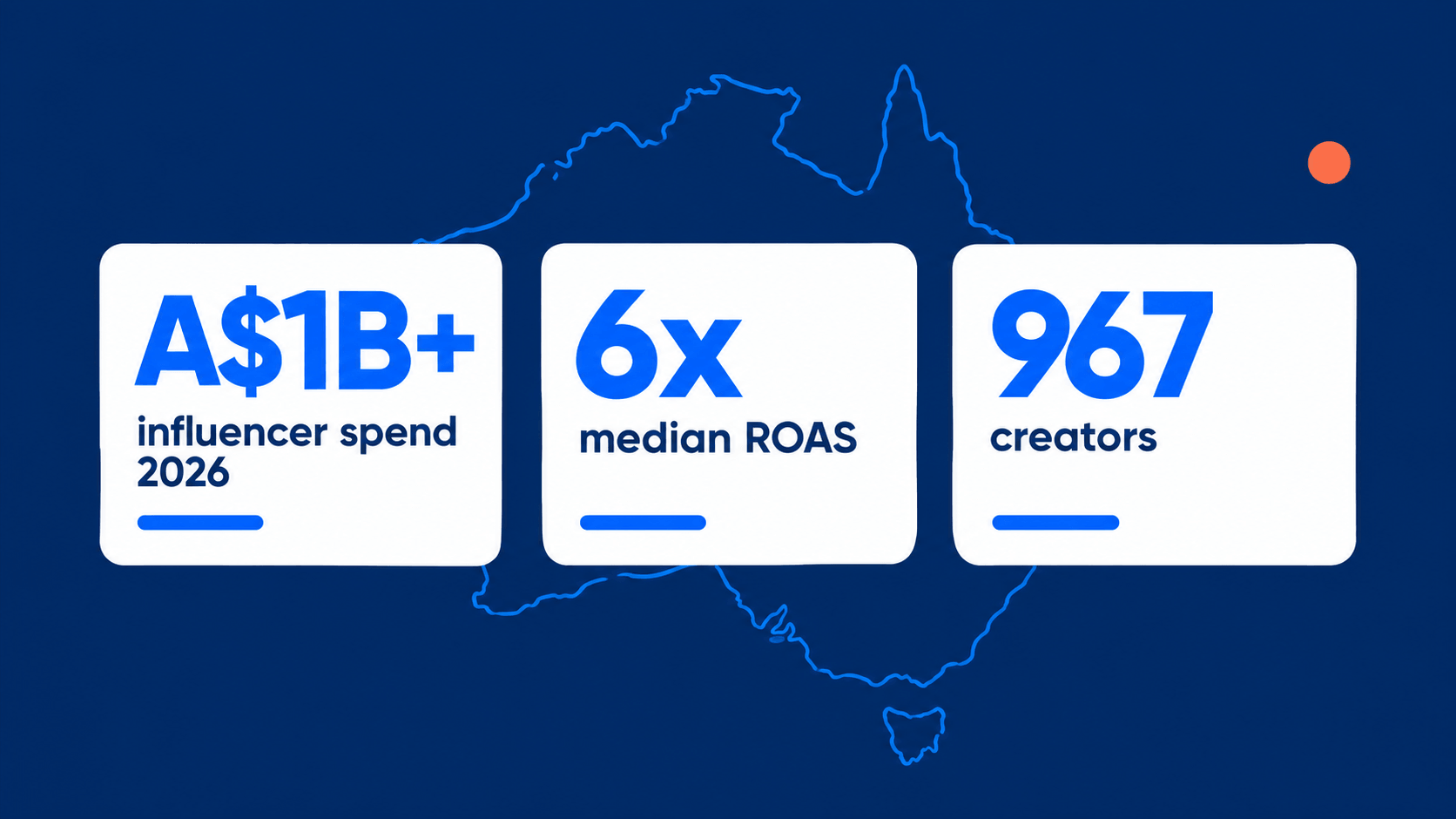
Australian brands spent an estimated A$830 million on influencer advertising in the 12 months to early 2026, up 13.5% year on year. Spend is projected to pass A$1 billion in 2026 (Meltwater and We Are Social, Digital 2026 report, as reported by Mumbrella in March 2026). For ecommerce brands, the more useful number is return. Across seven published Referwo campaigns, brands worked with 967 creators and published more than 2,055 pieces of content. Where return on ad spend (ROAS) was reported, the median was 6x (Referwo data, 2024 to 2026).
Creators are also where Australians now find brands. 61% of Australians discover brands through creators, rising to 85% of people under 40 (IAB Australia and Pureprofile, September 2026). Regulation tightened in the same year. In March 2026 the ACCC issued its first penalties against a brand over undisclosed gifted influencer reviews.
This page collects the 2026 numbers in one place. Every figure from our own campaigns is labelled “Referwo data” and traced to a published case study. Every external figure names its source and date.
Quick Answer
Three numbers frame Australian influencer marketing in 2026. Influencer advertising spend is projected to pass A$1 billion this year (Meltwater and We Are Social, 2026). 61% of Australians now discover brands through creators (IAB Australia, September 2026). Across seven Referwo ecommerce campaigns, the median ROAS was 6x, with published results ranging from 5.2x to 8x (Referwo data, 2024 to 2026). Results depend on product, audience and execution.
Key facts: influencer marketing in Australia (October 2026)
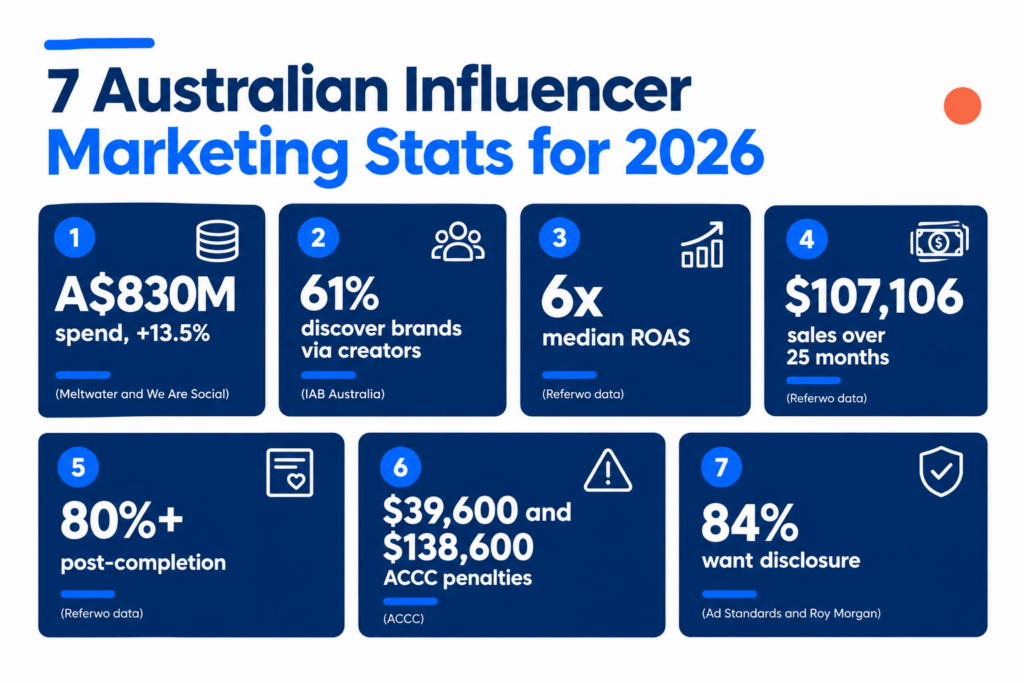
- Spend is heading past A$1 billion. Australian influencer advertising reached A$830 million over the past 12 months, up 13.5% (Meltwater and We Are Social, Digital 2026, reported March 2026).
- Creators drive discovery. 61% of Australians discover brands through creators, and 85% of under-40s do (IAB Australia and Pureprofile, September 2026, n=1,079).
- Median ROAS of 6x. Five Referwo campaigns that published ROAS ranged from 5.2x to 8x, with a median of 6x (Referwo data, 2024 to 2026).
- Sales keep coming. Eco Cleaning Product Brand recorded $107,106 in tracked sales over 25 months from 139 creators (Referwo data, 2026).
- Creators post. Active Referwo campaigns record a post-completion rate above 80% (Referwo data, 2026).
- Penalties have started. The ACCC fined PhotobookShop $39,600 (March 2026) and Hismile $138,600 (June 2026) over misleading social content (ACCC, 2026).
- Audiences expect disclosure. 84% of Australians say influencers should disclose when content is advertising (Ad Standards and Roy Morgan, July 2026, n=1,006).
How much do Australian brands spend on influencer marketing in 2026?
Australian brands spent an estimated A$830 million on influencer advertising in the 12 months to early 2026, up 13.5% on the previous year. The same report projects spend will pass A$1 billion during 2026. Influencer advertising is the second-fastest-growing digital category in Australia, behind online retail.
Where the A$1 billion figure comes from
The spend estimate comes from the Digital 2026 report by Meltwater and We Are Social, as reported by Mumbrella in March 2026. Treat the figure as an industry estimate, not a government statistic.
IAB Australia’s FY26 internet advertising report does not break influencer spend out as its own line. That matters when you compare numbers across sources. Each source measures spend differently, so a single headline figure should anchor a business case, not prove it.
How influencer spend sits inside the wider digital ad market
Australian internet advertising reached $19.8 billion in FY26, up 14.0%, the fastest growth since FY22 (IAB Australia, August 2026). Search took $8.6 billion, up 13.2%. Video took $5.9 billion, up 18.8%.
Social video was the standout. Social video spend reached $2.4 billion, up 29.5% in a single year (IAB Australia, August 2026). Creator content competes for the same scroll as that paid social video, which is one reason brands are testing creators alongside their ad accounts.
What an ecommerce influencer budget actually covers
Public data on average campaign budgets by brand size in Australia is thin, so we use our own campaign data instead. For gifted and commission-based campaigns, spend is mostly product cost plus commission paid on tracked sales.
Eco Cleaning Product Brand paid $17,524 in affiliate commissions over 25 months, against $107,106 in tracked sales (Referwo data, 2026). Dividing each campaign’s published sales by its ROAS gives the implied spend below.
| Brand | Published sales | Published ROAS | Implied spend | Implied spend per creator |
|---|---|---|---|---|
| Eco Cleaning Product Brand | $107,106 (25 months) | 6x | About $17,850 | About $128 |
| Hannah & Henry | Nearly $44,000 | 5.2x | About $8,460 | About $71 |
| Thread the Word | About $50,000 | 6x | About $8,330 | About $48 |
| Cherub Baby | About $30,000 | 8x | About $3,750 | About $32 |
| Sole Sox | About $10,000 | 6.5x | About $1,540 | About $12 |
Source: Referwo data, published case studies, 2024 to 2026. Implied spend is published sales divided by published ROAS, rounded. It is an estimate, not an invoice total.
The pattern is useful for planning. Gifted campaigns with tracked codes can run on a product budget measured in thousands, not tens of thousands. Our guide to influencer marketing costs in Australia breaks down what to budget line by line.
What ROAS do Australian ecommerce brands get from influencer campaigns?
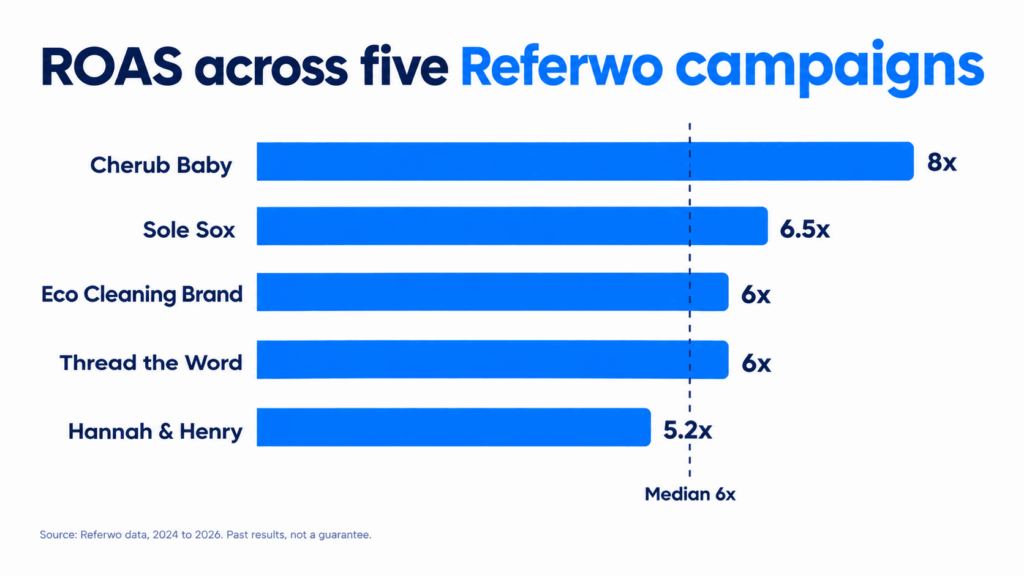
Across the five Referwo ecommerce campaigns that published ROAS, results ranged from 5.2x to 8x, with a median of 6x (Referwo data, 2024 to 2026). Cherub Baby recorded the highest at 8x. Hannah & Henry recorded 5.2x on a gifted campaign. These are past results, not a forecast for your brand.
Return on ad spend (ROAS):
Revenue attributed to a campaign divided by what the campaign cost. A 6x ROAS means $6 in tracked sales for every $1 spent on product, commissions and creator fees.
ROAS by campaign
- Cherub Baby: 8x ROAS and 450% ROI from 119 creators (Referwo data).
- Sole Sox: 6.5x ROAS and 350% ROI from 127 creators (Referwo data).
- Eco Cleaning Product Brand: 6x ROAS and 511% ROI over 25 months from 139 creators (Referwo data).
- Thread the Word: 6x ROAS and 283% ROI from 174 creators (Referwo data).
- Hannah & Henry: 5.2x ROAS and 265% ROI from 119 creators (Referwo data).
Why the tracking window changes the number
A campaign’s ROAS depends on how long you keep counting. When the Eco Cleaning Product Brand case study was first published, the campaign had recorded $41,888 in tracked sales. Twenty-five months later, the total was $107,106 (Referwo data, 2026).
Eco Cleaning Product Brand’s creator codes kept selling long after the posts went live. The brand recorded $43,299 in tracked sales in less than seven months of 2026 alone. If Eco Cleaning Product Brand had measured at 30 days, the business case would have missed most of the return.
Sales concentrate in a small group of creators
In the Eco Cleaning Product Brand campaign, 51 of the 139 creators drove tracked sales, about one in three. The top four creators produced more than $74,000 of the $107,106 total (Referwo data, 2026).
Nobody could have picked those four in advance. That is the case for activating a larger creator pool and letting tracked codes show you who sells. Read how Eco Cleaning Product Brand grew tracked sales over 25 months for the full breakdown.
How influencer ROAS compares with paid search and social
We have not found a verified, Australia-specific ROAS benchmark for Meta or Google ads that we are willing to publish. Paid media returns vary too widely by category, margin and attribution setting for one industry average to be reliable.
The fair comparison is your own. Compare creator ROAS against your own Meta and Google ROAS, using the same attribution window and the same cost inputs. Our guide to tracking ROI from influencer marketing shows how to set that up.
Campaign results table: seven Referwo case studies
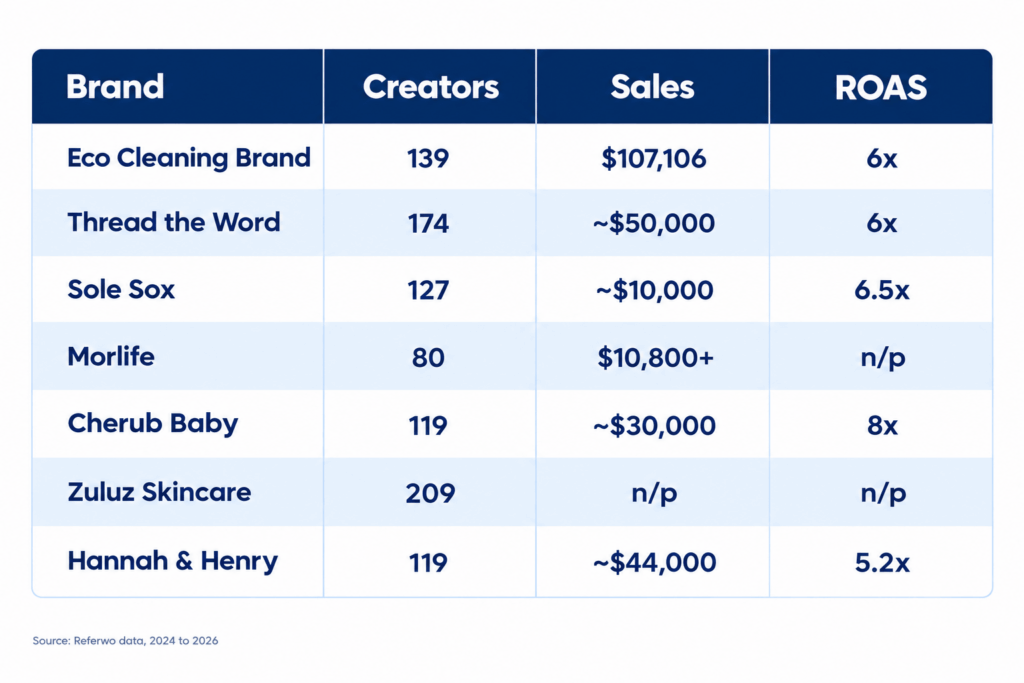
Seven Referwo campaigns for Australian ecommerce brands activated 967 creators and produced more than 2,055 pieces of content. Six campaigns published sales, totalling more than $250,000 in tracked and estimated sales (Referwo data, 2024 to 2026). The table shows each campaign as published.
| Brand | Campaign model | Creators | Content pieces | Sales attributed | ROAS |
|---|---|---|---|---|---|
| Eco Cleaning Product Brand | Gifted + affiliate codes | 139 | 400+ | $107,106 (25 months) | 6x |
| Thread the Word | Gifted | 174 | 480 | About $50,000 (est.) | 6x |
| Sole Sox | Gifted + affiliate codes | 127 | 186 | About $10,000 (est.) | 6.5x |
| Morlife | Tracked discount codes | 80 | 245 | $10,800+ (est.) | Not published |
| Cherub Baby | Tracked discount codes | 119 | 180+ | About $30,000 (est.) | 8x |
| Zuluz Skincare | Awareness and UGC | 209 | 304 | Not published | Not published |
| Hannah & Henry | Gifted + discount codes | 119 | 260 | Nearly $44,000 | 5.2x |
Source: Referwo data, published case studies, 2024 to 2026, figures as at October 2026. “Est.” marks figures the case study itself labels as estimates.
How to read the table
- Creator counts are approved creators. Each figure is the number of creators the brand approved and activated.
- Sales are tracked through creator codes. Each creator receives a unique discount code or link.
- Estimated figures are labelled. Where a case study reports an estimate, the table says so.
- Zuluz Skincare ran an awareness campaign. Zuluz recorded 305,541 views, 35,512 likes and 3,587 comments, so sales and ROAS were not the goal.
- Morlife has not published ROAS. Morlife reported a $10,800+ estimated sales increase and 250,000+ impressions.
What the seven campaigns have in common
Each campaign activated between 80 and 209 creators rather than relying on one or two large names. Most combined gifted product with tracked codes, so the brand paid for product up front and commission only on sales.
The categories are everyday ecommerce: baby and parenting products, natural cleaning, health foods and skincare. See all Referwo case studies for the full write-ups.
Run your own numbers
Referwo tracks every creator’s sales through unique discount codes and links, so your ROAS is measured from day one. Start your influencer campaign on Referwo with a 14-day free trial on the Basic and Standard plans and no lock-in contract.
What do creators charge per post in Australia in 2026?
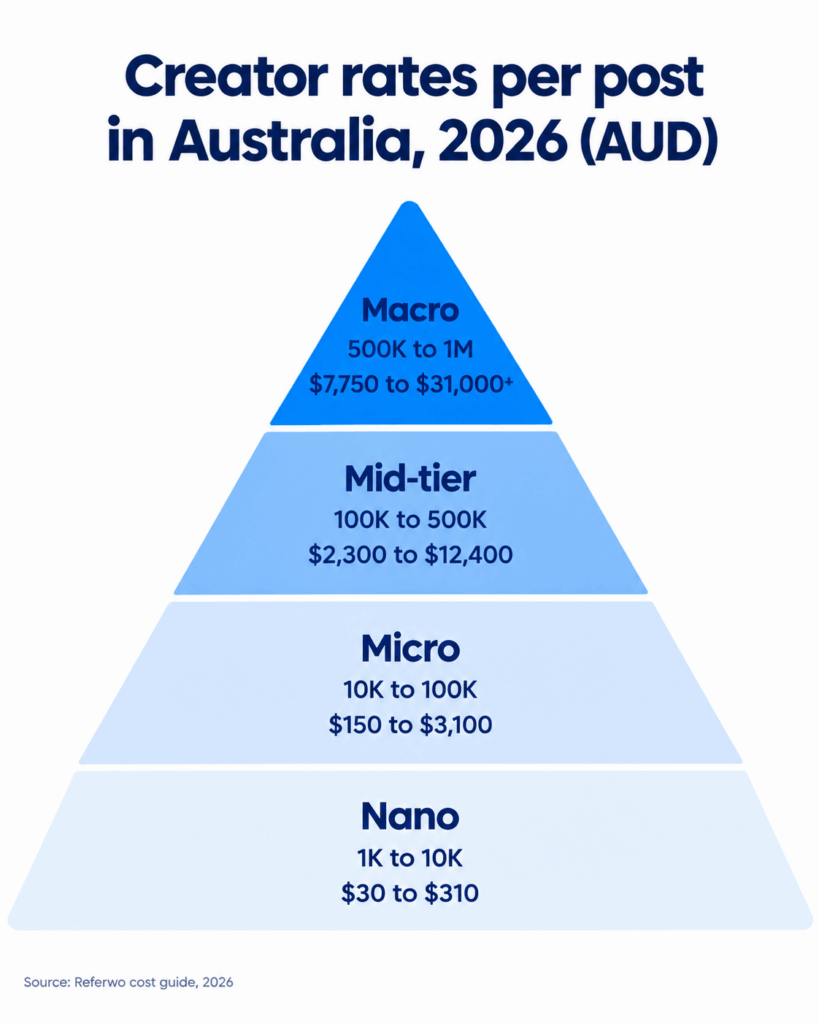
Referwo’s 2026 rate guide puts nano creators (1,000 to 10,000 followers) at about AUD 30 to 310 per post and micro creators (10,000 to 100,000) at AUD 150 to 3,100. Mid-tier and macro creators charge thousands per post. Many nano and micro creators also accept gifted product instead of a fee.
| Creator tier | Follower range | Indicative rate per post (AUD) |
|---|---|---|
| Nano | 1,000 to 10,000 | $30 to $310 |
| Micro | 10,000 to 100,000 | $150 to $3,100 |
| Mid-tier | 100,000 to 500,000 | $2,300 to $12,400 |
| Macro | 500,000 to 1 million | $7,750 to $31,000+ |
Source: Referwo influencer marketing cost guide, 2026. Ranges are indicative; rates vary by platform, format, usage rights and niche.
Why the ranges are so wide
A per-post rate bundles several things: the content itself, the creator’s reach, usage rights and exclusivity. A micro creator charging $150 for an Instagram Story and $3,100 for a Reel with paid usage rights sits inside the same tier.
Engagement matters more than follower count. Referwo’s engagement guide treats 3% to 6% as good and above 10% as exceptional, usually from niche creators. Our micro influencer engagement analysis explains how to check it before you agree a fee.
Gifted, paid and commission models compared
Most campaigns in the results table paid little or nothing per post. Creators received product, then earned commission on tracked sales. That model shifts cost from fixed fees to results.
| Model | What the brand pays | Best for | Main trade-off |
|---|---|---|---|
| Gifted | Product cost and shipping | Volume content and first tests | Creators may not post without a clear brief |
| Paid | Fixed fee per post or package | Specific deliverables and timing | Cost is fixed whether sales follow or not |
| Commission (affiliate) | A percentage of tracked sales | Ongoing sales from proven creators | Slower to start, needs tracking set up |
Many brands combine all three. Read our comparison of affiliate, gifted and paid influencer campaigns to choose a starting mix.
What changed for influencer marketing in Australia in 2026?
Four things changed in 2026. The ACCC moved from warnings to penalties over undisclosed influencer content. Audiences said clearly that they expect disclosure. Creators became a primary discovery channel, including through AI search. Paid digital advertising kept growing, raising competition for attention.
The ACCC moved from warnings to penalties
On 24 March 2026, the Australian Competition and Consumer Commission (ACCC) announced that PhotobookShop paid $39,600 in penalties under two infringement notices. PhotobookShop had told creators on 107 occasions not to disclose that products were gifted.
On 12 June 2026, the ACCC announced that Hismile paid $138,600 in penalties under seven infringement notices. Hismile’s social videos had presented its own employees as random shoppers.
The problem is not new. An earlier ACCC sweep found that 81% of 118 influencers reviewed made posts that raised concerns (ACCC, December 2023). The difference in 2026 is that brands are now paying penalties.
Audiences expect disclosure
84% of Australians say influencers should disclose when content is advertising, and 57% encounter influencer marketing every day (Ad Standards and Roy Morgan, July 2026). About 80% said a failure to disclose paid promotions would hurt their view of the brand or creator.
Referwo campaign briefs do not add disclosure by default. Brands add the disclosure requirement and hashtags such as #ad to the brief themselves, and should check them at content approval.
Creators became a discovery channel, including in AI search
61% of Australians now discover brands through creators (IAB Australia and Pureprofile, September 2026). 86% weigh brand reputation and 84% consider creator expertise before acting on a creator’s recommendation.
AI search adds a new path. 23% of Australian AI users have discovered creators through AI-generated results and now follow them (IAB Australia, The Creator Signal, May 2026). Creator content that names your brand is now part of how AI tools learn what your brand is.
Paid digital competition kept rising
Australian internet advertising grew 14.0% in FY26 to $19.8 billion, and social video grew 29.5% (IAB Australia, August 2026). More money chasing the same feeds raises competition for attention in paid placements.
Commission-based programs extended campaign life
The Eco Cleaning Product Brand result shows what an always-on commission program can do. Creator codes that kept earning commission kept selling for 25 months. Our affiliate influencer marketing strategy guide covers how to structure commission rates and codes.
How should you use these benchmarks in a business case?
Use these benchmarks to set realistic targets, not promises. Start with a ROAS target near the 6x median, count every cost, choose a long enough attribution window, and plan for only one in three creators to drive sales. Then review results quarterly against your own paid media.
- Set a ROAS target. Use 5x to 6x as a planning range, based on the Referwo median, and treat anything above it as upside.
- Count every cost. Include product cost, shipping, commissions and any creator fees in the spend figure.
- Choose the attribution window. Decide the time period in which a sale is credited to a creator, and keep counting beyond 30 days.
- Plan creator volume. Activate enough creators that one in three driving sales still hits your target.
- Write disclosure into the brief. Require #ad or the platform’s paid partnership label before any product ships.
- Review quarterly. Compare creator ROAS with your Meta and Google ROAS using the same inputs.
A worked example: a brand gifts product worth $40 to 100 creators, so product spend is $4,000. At a 6x ROAS on that spend, the target is $24,000 in tracked sales before commission. If one in three creators sells, about 33 creators need to average roughly $730 each.
How does Referwo collect and report this data?
Referwo data comes from campaigns run on the Referwo platform and published as case studies. Sales are tracked through unique creator discount codes and links in the brand’s Shopify or WooCommerce store. Figures are reported as published, and estimates are labelled.
- Data window: Campaigns ran between 2024 and 2026.
- Data cut-off: Figures are as published on 1 October 2026.
- Sales tracking: Each creator receives a unique discount code or link.
- ROAS and ROI: Figures are as reported in each case study.
- Post-completion rate: The share of approved creators who publish the agreed content, across active campaigns.
This article is updated quarterly. Last updated: October 2026. The next scheduled update is January 2027.
Frequently asked questions
How big is the influencer marketing industry in Australia in 2026?
Australian influencer advertising reached an estimated A$830 million over the 12 months to early 2026, up 13.5%. Spend is projected to pass A$1 billion during 2026 (Meltwater and We Are Social, Digital 2026, reported March 2026).
What is a good ROAS for an influencer marketing campaign in Australia?
Across five Referwo ecommerce campaigns that published ROAS, results ranged from 5.2x to 8x, with a median of 6x (Referwo data, 2024 to 2026). A planning target of 5x to 6x is realistic for gifted and commission campaigns, but results depend on product, margin and execution.
How much do micro influencers charge in Australia?
Referwo’s 2026 rate guide puts micro creators (10,000 to 100,000 followers) at about AUD 150 to 3,100 per post. Many micro creators also accept gifted product plus commission on tracked sales instead of a fixed fee.
What percentage of Australians discover brands through influencers?
61% of Australians discover brands through creators, rising to 85% of Australians under 40 (IAB Australia and Pureprofile, September 2026, n=1,079).
Are Australian brands increasing their influencer marketing budgets in 2026?
Yes. Influencer advertising spend grew 13.5% year on year to an estimated A$830 million and is projected to pass A$1 billion in 2026 (Meltwater and We Are Social, 2026).
What is a good engagement rate for micro influencers in Australia?
Referwo’s engagement guide treats 3% to 6% as good, 6% to 10% as strong and above 10% as exceptional. Exceptional rates usually come from niche creators with closely matched audiences.
How does influencer marketing ROAS compare to Facebook Ads in Australia?
There is no verified Australia-wide Facebook Ads ROAS benchmark we are willing to publish. Compare creator ROAS with your own Meta ROAS using the same attribution window and cost inputs. Referwo campaigns recorded a median 6x ROAS (Referwo data).
How many creators worked on the Referwo campaigns in this report?
The seven Referwo campaigns in this report activated 967 creators and produced more than 2,055 pieces of content (Referwo data, 2024 to 2026).
What types of influencer campaigns get the highest ROAS in Australia?
In Referwo data, campaigns combining gifted product with tracked discount codes recorded 5.2x to 8x ROAS. Cherub Baby recorded the highest published ROAS at 8x using tracked creator codes.
How have ACCC enforcement actions affected influencer marketing in Australia?
The ACCC issued penalties of $39,600 to PhotobookShop in March 2026 over undisclosed gifted reviews, and $138,600 to Hismile in June 2026 over misleading social videos. Brands are now accountable for disclosure in their creator campaigns.
Which creator tier performs best in Australia: nano, micro or mid-tier?
Every Referwo campaign in this report activated between 80 and 209 creators, with the Eco Cleaning Product Brand and Thread the Word campaigns built on micro and mid-tier creators. Sales still concentrated in a few creators: in the Eco Cleaning Product Brand campaign, 51 of 139 creators drove tracked sales.
Where can I find Australian influencer marketing statistics for my business case?
This page collects verified 2026 figures from the ACCC, IAB Australia, Ad Standards and Roy Morgan, plus first-party Referwo campaign data. It is updated quarterly, with the next update due in January 2027.
The bottom line
The headline numbers will keep moving, but the pattern in the data is stable. Brands that measure creator sales with tracked codes, count for long enough and activate enough creators can see returns that hold up against paid media.
The brands in this report did not guess which creators would sell. They tested at volume and let the data decide. If you want every creator’s sales tracked from the first post, start your influencer campaign on Referwo.
Sources
- ACCC: PhotobookShop pays penalties for influencer reviews (24 March 2026)
- ACCC: Hismile pays penalties for false and misleading social media videos (12 June 2026)
- ACCC: Social media influencer testimonials sweep (December 2023)
- IAB Australia: Internet advertising records strongest growth in four years, FY26 (August 2026)
- IAB Australia and Pureprofile: Commerce and Discovery Report 2026 (September 2026)
- IAB Australia: The Creator Signal (May 2026)
- Ad Standards and Roy Morgan: Advertising disclosure and transparency (July 2026)
- Meltwater and We Are Social: Digital 2026 report, as reported by Mumbrella (March 2026)
- Referwo case studies, 2024 to 2026
About the author: Ewen Ling is the co-founder of Referwo and an ecommerce entrepreneur with 16 years of hands-on experience. He co-founded Elinz Electronics in 2005 and scaled it into a fully operational business before managing a successful exit for shareholders in 2021. At Referwo, Ewen helps ecommerce brands build influencer marketing programmes that generate measurable revenue, not just reach.